

Training a parrot does not have to be complicated. You do not need a long list of commands or special equipment to get started. A few minutes of calm, regular practice can help your bird become more comfortable with you and learn useful behaviors.
The first goal should not be teaching tricks. Start by building trust and helping your parrot understand that spending time with you is a safe and pleasant experience. Once your bird is comfortable, simple behaviors such as stepping onto your hand become much easier to teach.
Every parrot learns at its own pace. Some birds will respond quickly, while others need more time before they feel comfortable participating. Patience and consistency are more useful than trying to rush the process.
[wpsm_toplist]
1. Build Trust Before You Start Training
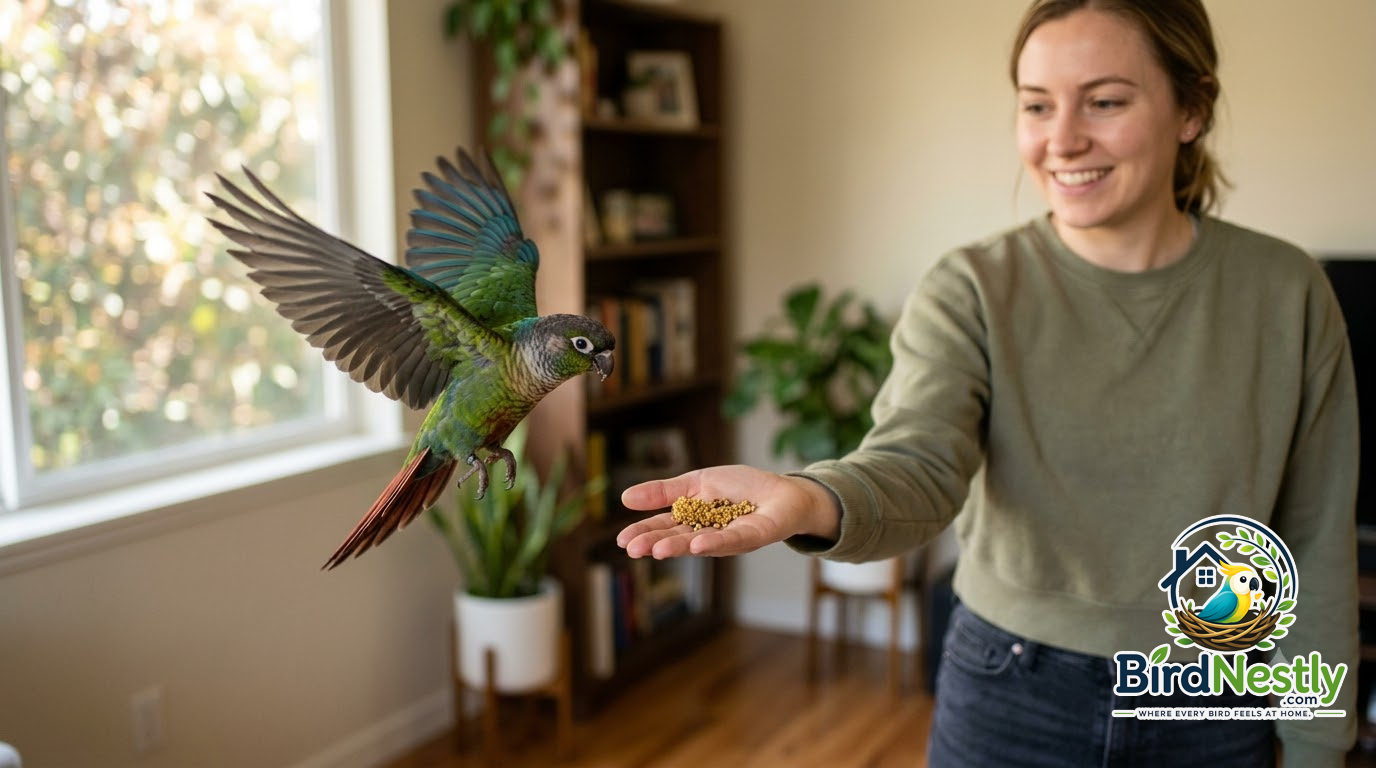
Trust should come before formal training. A parrot that is nervous around your hands or avoids you will have difficulty concentrating on what you are trying to teach.
Start by spending time near your bird without asking it to do anything. Talk to your parrot in a calm voice and allow it to watch you. If the bird remains relaxed, you can gradually offer a small favorite treat from your hand.
Do not chase your parrot around the cage or force it to interact with you. If it moves away, give it some space. The goal is for your bird to become comfortable choosing to come closer.
Watch its body language carefully. A relaxed parrot may sit comfortably, preen, eat, or show curiosity toward you. A frightened bird may move away, become stiff, open its beak, or try to avoid your hand.
Respecting these signals is an important part of building trust. This can also help prevent biting, especially if your parrot has already shown defensive behavior. Understanding why your parrot bites can make training much easier.
Keep the first interactions short. A few positive minutes are better than a long session that leaves your bird stressed or tired.
Once your parrot willingly approaches you, accepts treats, and remains relaxed around your hands, you have a much better starting point for training.
2. Teach Your Parrot to Step Up
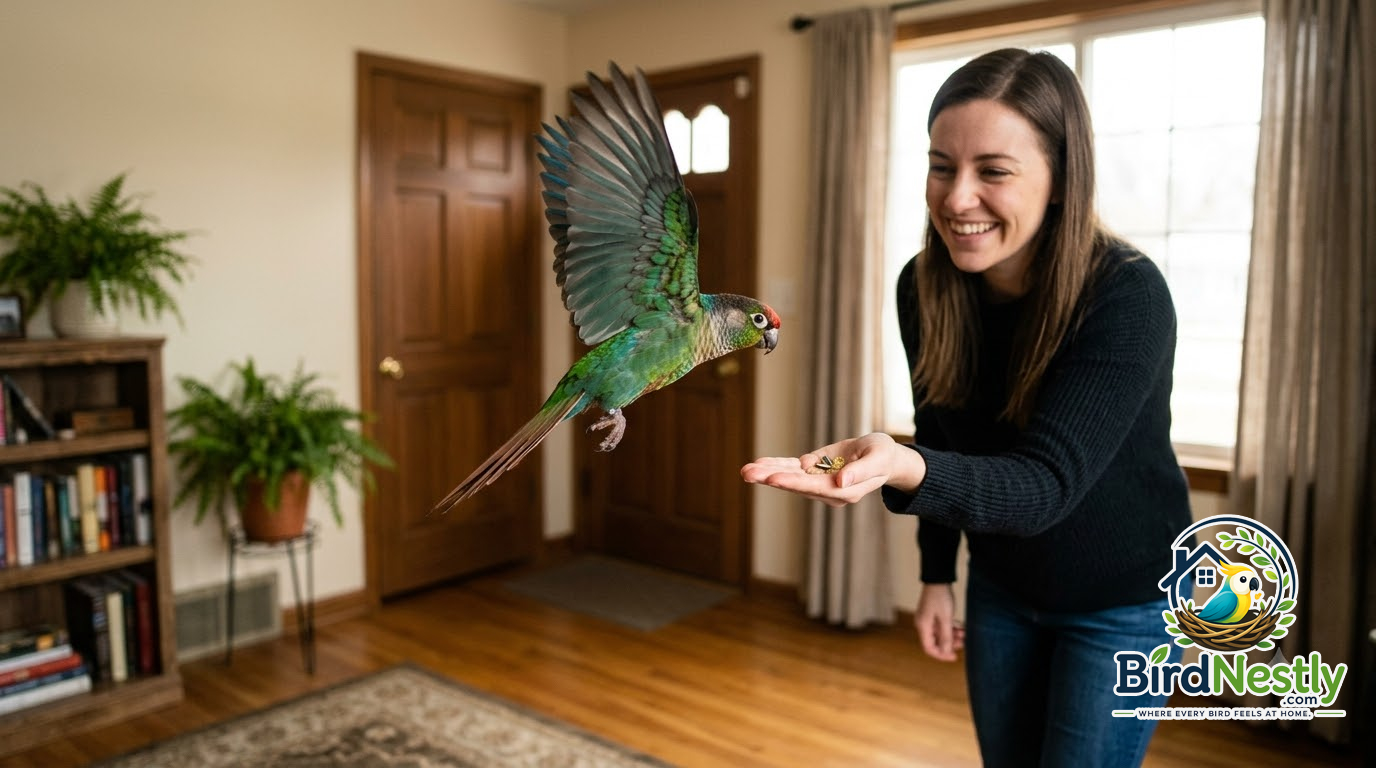
“Step up” is one of the most useful behaviors to teach a parrot. It makes everyday handling easier and gives your bird a simple way to move from one place to another without being grabbed.
Choose a quiet time when your parrot is relaxed. Hold your finger or a suitable perch near the lower part of its chest, just above the feet. Use the same short phrase each time, such as “step up.”
When your parrot moves onto your finger or perch, give it praise and a small reward immediately. The reward helps your bird understand which behavior earned the positive response.
Do not push your hand forcefully against the bird or try to make it step up if it is clearly frightened. If your parrot moves away, pause and try again later.
At first, even putting one foot onto your hand can be worth rewarding. Gradually, your bird will learn that stepping onto your hand leads to something pleasant.
Practice for only a few minutes at a time. End the session while your parrot is still comfortable and interested.
Once your bird understands the basic step-up cue, you can gradually practice moving from one perch to another, stepping onto your hand from different positions, and eventually responding to the cue in different areas of the home.
3. Use Rewards to Encourage Good Behavior
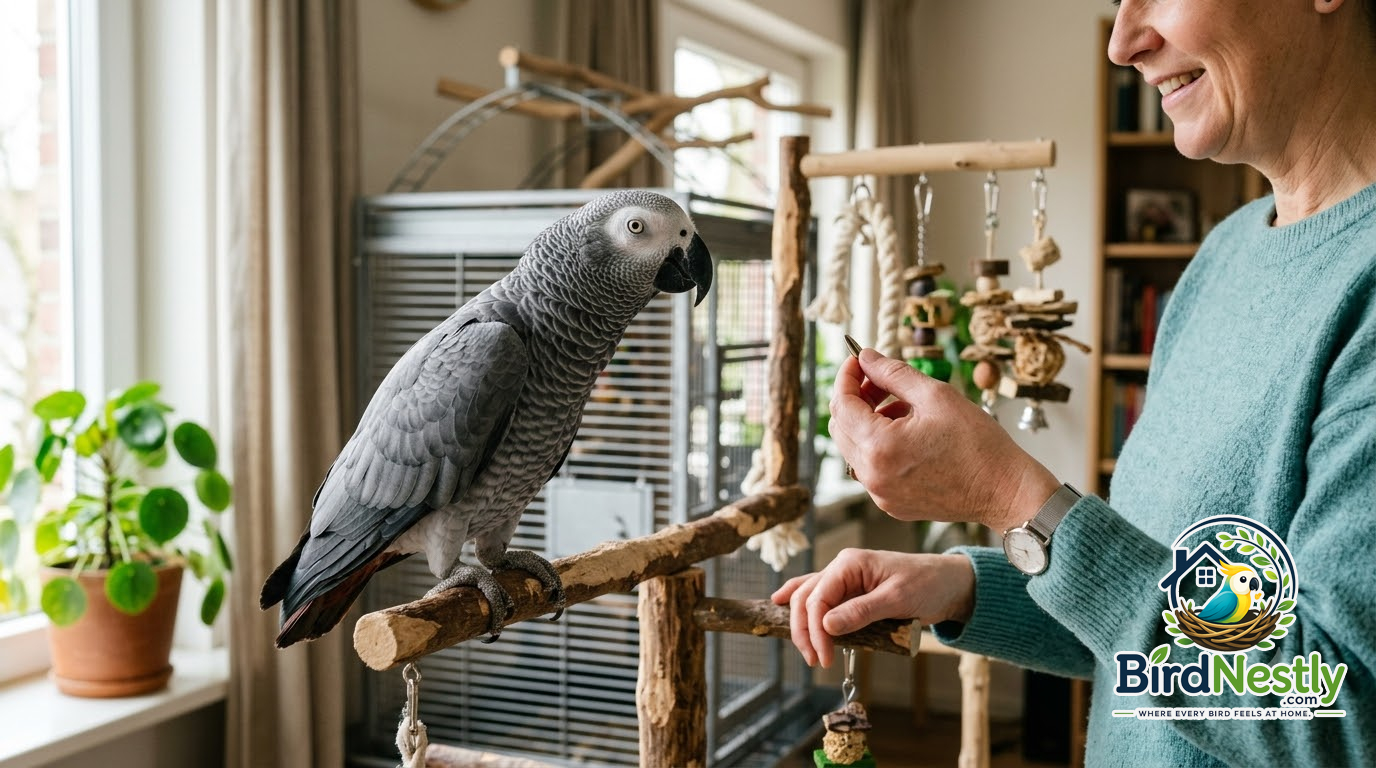
Parrots learn best when they understand exactly which behavior earns a reward. Instead of waiting for your bird to make a mistake and correcting it, focus on rewarding the behavior you want to see again.
Choose a small treat that your parrot really enjoys. It could be a tiny piece of fruit, a favorite seed, or another food that already fits into its normal diet. Keep the pieces small so your bird can eat them quickly and return to training.
Timing matters. When your parrot performs the behavior correctly, offer the reward right away. Waiting too long can make it harder for the bird to understand what earned the treat.
For example, when teaching step-up:
Your cue → parrot steps onto your hand → immediate reward
Repeat this several times, then give your bird a break.
Praise can also be useful. Use the same friendly word or phrase when your parrot does something correctly. Over time, your bird may respond to your voice even before receiving a food reward.
Do not reward biting, screaming, or other behavior you are trying to reduce. If your parrot becomes frustrated, stop for a moment and return to an easier task.
The reward does not always have to be food. Some parrots enjoy praise, head scratches, toys, or simply being allowed to return to a favorite perch. Pay attention to what motivates your particular bird.
4. Keep Training Sessions Short and Consistent
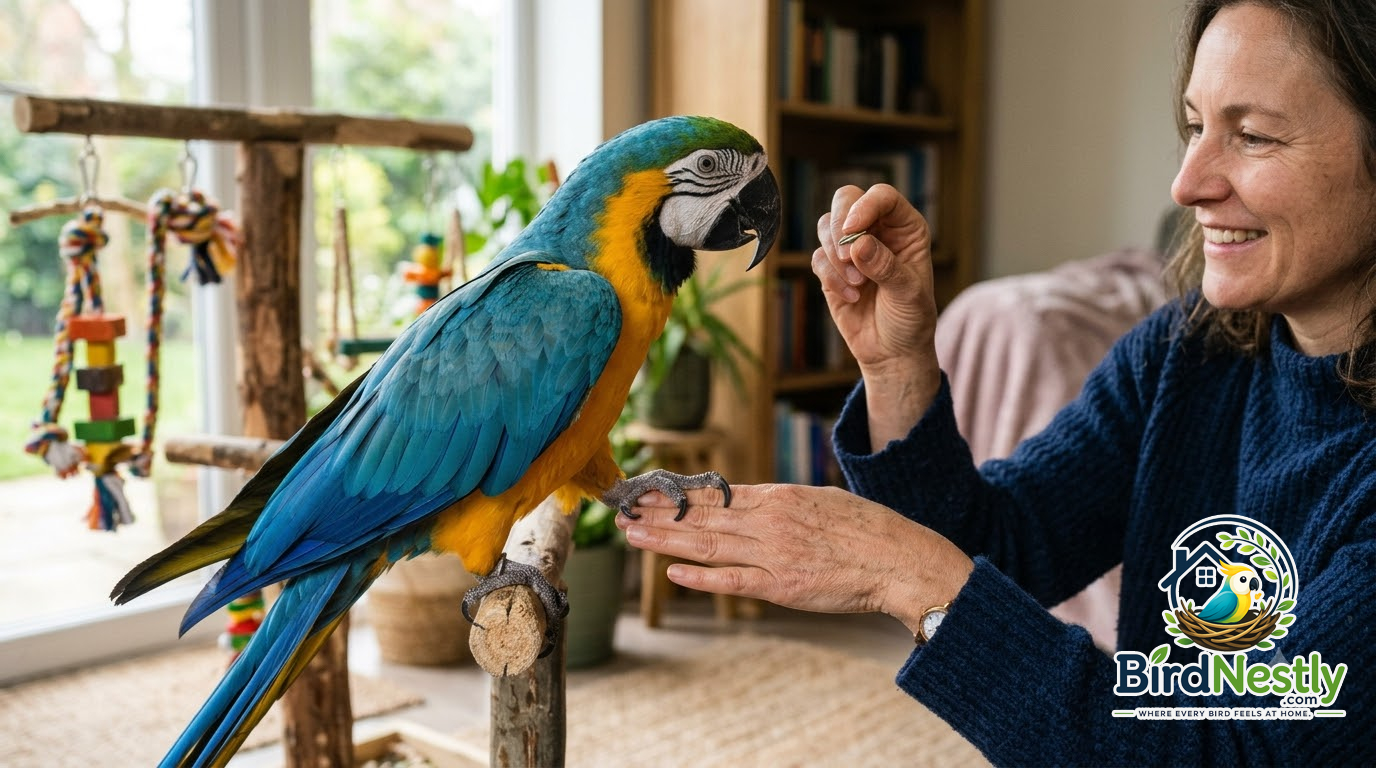
A long training session can quickly become tiring for a parrot. Short sessions are usually easier for both you and your bird.
Start with around five to ten minutes. If your parrot remains interested and relaxed, you can gradually build up the amount of practice over time.
Try to train at roughly the same time each day when possible. A familiar routine helps your bird know what to expect.
Watch your parrot during each session. If it starts walking away, losing interest, becoming distracted, refusing treats, or showing signs of stress, it may be time to stop.
It is better to finish after a successful response than to keep going until your bird becomes frustrated.
You also do not need to teach several behaviors at once. Pick one simple goal and practice it repeatedly until your parrot understands it. Once that behavior becomes reliable, move on to something more difficult.
Regular practice is more important than spending a large amount of time training once in a while. A few calm sessions spread throughout the week can produce better results than occasional long sessions.
If your parrot enjoys learning sounds and words, you can later move into more advanced training with our guide on how to train a parrot to talk.
5. Teach Your Parrot to Come When Called
Once your parrot is comfortable stepping onto your hand, you can begin teaching it to come to you. This is a useful skill for everyday handling and can also help strengthen the connection between you and your bird.
Start at a very short distance. Ask your parrot to step onto your hand, then move just a little farther away and offer a familiar cue, such as its name or “come here.”
When your parrot moves toward you, reward it immediately.
Do not begin by calling your bird from across the room. The distance should be short enough that your parrot has a good chance of succeeding. As it becomes more reliable, gradually increase the distance.
Keep the surroundings safe during this type of training. Close doors and windows and make sure there are no hazards nearby before allowing your parrot to move or fly toward you.
If your bird ignores the cue, avoid repeatedly calling its name. Move closer and make the exercise easier instead. You want the cue to become associated with a successful response rather than repeated commands.
With regular practice, your parrot can learn that coming toward you leads to something pleasant.
6. Teach One Command at a Time
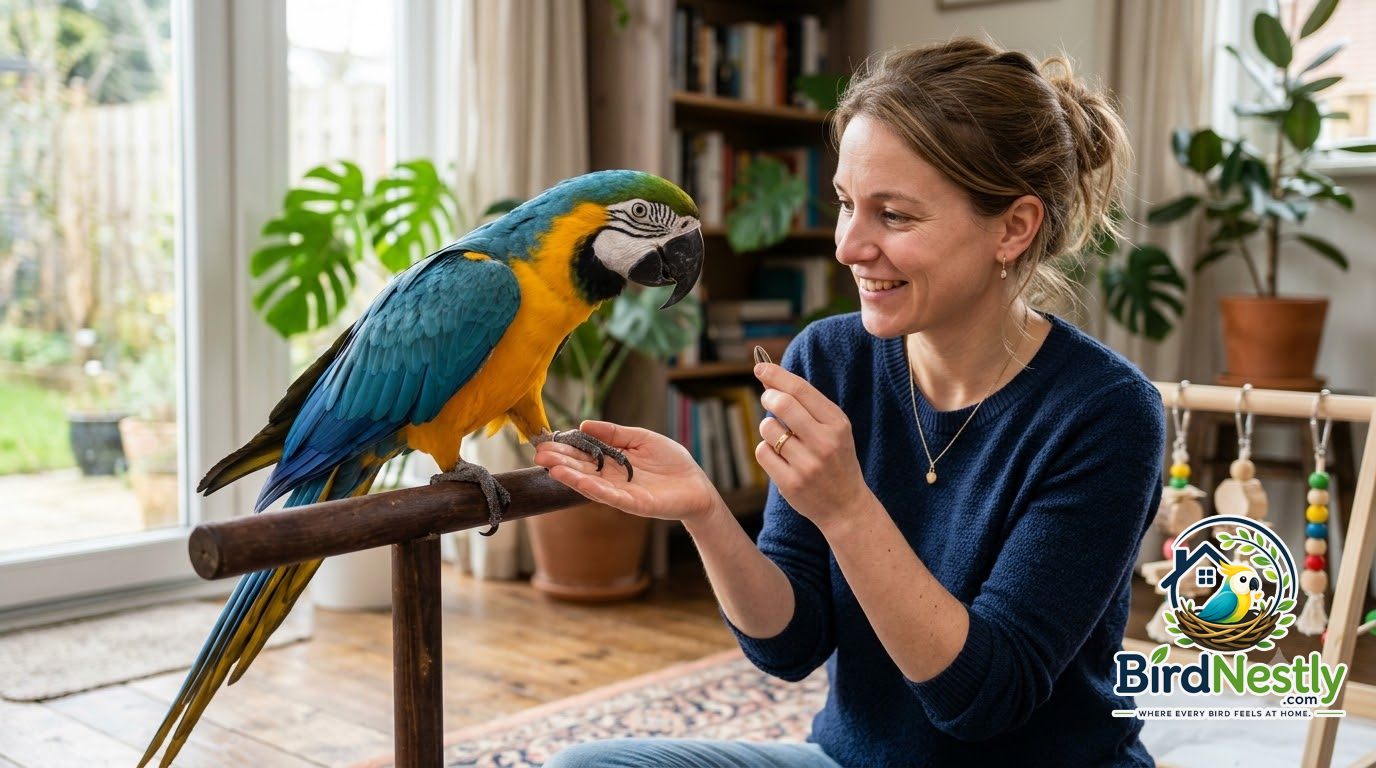
Parrots can learn several behaviors, but introducing too many commands at once can make training confusing.
Choose one behavior and use the same word or gesture every time. For example, use “step up” whenever you want your bird to step onto your hand.
Once your parrot understands the command, practice it in different situations. Start somewhere quiet, then gradually practice in other familiar areas of the home.
Keep your instructions simple. A short, consistent cue is easier for your bird to recognize than a long sentence that changes from one session to another.
You can later introduce other useful behaviors such as:
- Step up
- Step down
- Come here
- Stay
- Go to perch
- Touch
- Turn around
Teaching these behaviors gradually gives your parrot time to understand each one.
If your bird gets a command wrong, simply reset and try an easier version. There is no need to scold or frighten it.
Training should feel like an activity you and your parrot do together, not a battle over who is in control.
Frequently Asked Questions
How do I start training my parrot?
Start by building trust. Spend time near your parrot, offer suitable treats, and allow it to become comfortable with your presence and hands. Once your bird is relaxed around you, begin with a simple behavior such as “step up.”
What is the easiest thing to teach a parrot?
Step up is one of the most useful behaviors for a young or newly trained parrot. It teaches the bird to move onto your hand or a perch when asked and makes everyday handling easier.
How long should I train my parrot each day?
Start with short sessions of around 5–10 minutes. Several short sessions can be more effective than one long session. Stop when your parrot loses interest or begins showing signs of stress.
How do I teach my parrot to step up?
Place your hand or a suitable perch near your parrot’s lower chest and use the same cue, such as “step up.” When your bird steps onto your hand, reward it immediately. Repeat the exercise regularly without forcing the bird.
Can an older parrot still be trained?
Yes. Older parrots can learn new behaviors. The process may take more patience if the bird already has established habits, but age alone does not prevent training.
How do I train my parrot to come to me?
Begin at a very short distance. Call your parrot using the same cue each time and reward it immediately when it moves toward you. Gradually increase the distance as your bird becomes more reliable.
What should I do if my parrot refuses to cooperate?
Do not force it. Make the exercise easier, use a reward your parrot enjoys, and try again later. Refusing to participate can mean your bird is tired, distracted, nervous, or simply not interested at that moment.
Should I punish my parrot for bad behavior?
No. Hitting, yelling, chasing, or frightening your parrot can damage trust and may make unwanted behavior worse. Focus on rewarding the behavior you want your bird to repeat.
How do I train my parrot not to bite?
First identify why the biting happens. Fear, territorial behavior, overstimulation, stress, and discomfort can all play a role. Learn your bird’s warning signals, respect its boundaries, and reward calm interactions.
How do I train my parrot to talk?
Choose a simple word or short phrase and repeat it regularly in a calm voice. Reward your parrot when it attempts the sound. Keep sessions short and practice consistently. For a more detailed approach, see our guide on how to train a parrot to talk.


Write Your Review
No reviews yet. Be the first to share your experience!