

Teaching a parrot to talk takes patience, repetition, and plenty of everyday interaction. Some parrots begin copying sounds quickly, while others need weeks or months before they say a recognizable word. A few may never become clear talkers, and that is perfectly normal.
The best place to start is with simple words your parrot hears often. Choose one word, say it clearly, and give your bird plenty of chances to hear it in a calm setting. When your parrot makes an effort to copy the sound, praise it and offer a small reward.
Do not worry about getting perfect pronunciation at the beginning. A rough attempt is still progress. What matters most is helping your parrot connect a particular sound with a positive experience.
[wpsm_toplist]
1. Build Trust Before Teaching Words

A parrot that feels comfortable around you is more likely to pay attention to your voice. Before focusing on speech, spend time developing a good relationship with your bird.
Sit near your parrot and talk to it in a relaxed voice. Use its name, greet it when you enter the room, and speak to it during normal daily activities. Your bird will gradually become familiar with the sound and rhythm of your voice.
Avoid forcing your parrot to interact with you. If it moves away, becomes tense, or shows signs of fear, give it some space. Trying to hold or restrain a nervous bird can make it less willing to interact with you later.
You can also use small treats to create positive associations. When your parrot approaches you, remains calm, or responds to your voice, offer praise or an appropriate treat.
Trust develops through repeated experiences. Your parrot should learn that being near you is safe and that interaction does not always lead to being grabbed or handled.
Once your bird willingly stays near you and pays attention when you speak, teaching words becomes much easier.
2. Choose One Simple Word to Start
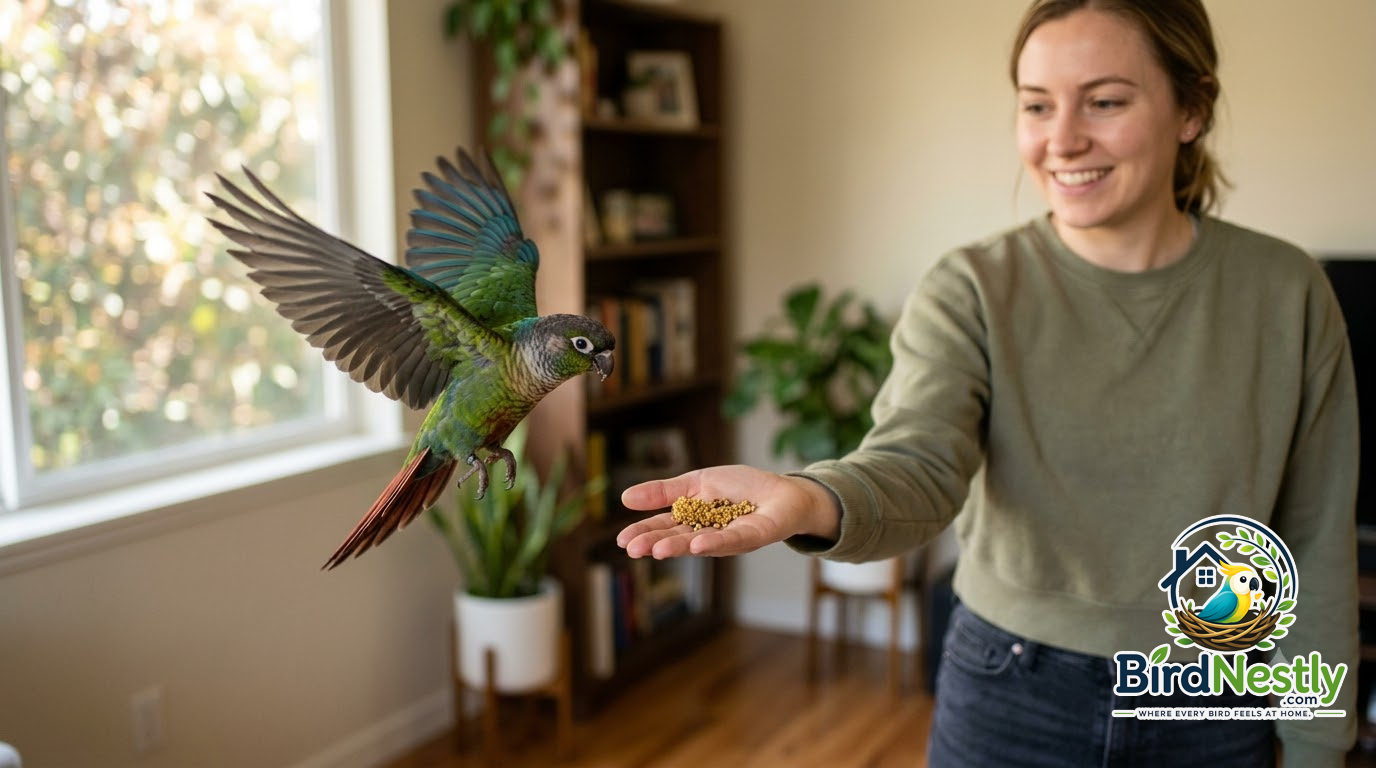
Do not begin by teaching several words at the same time. Pick one short word that your parrot hears frequently and use it consistently.
“Hello” is a simple choice because you can use it every time you enter the room. Other possibilities include:
- Hi
- Hello
- Good bird
- Come
- Pretty bird
Choose a word that is easy for you to pronounce clearly and easy to repeat in the same way each time.
Speak directly to your parrot and say the chosen word in a clear, friendly voice. Repeat it several times during a short session, then give your bird a break.
It can also help to use the word naturally throughout the day. For example, say “Hello” when you first see your parrot instead of only using the word during formal training.
Try to keep the pronunciation consistent. Changing the sound of the word every time can make it harder for your bird to recognize what you want it to copy.
Once your parrot begins making sounds that resemble the target word, respond immediately with praise and a small reward. Even an imperfect attempt can be worth encouraging.
3. Repeat the Word Clearly and Consistently
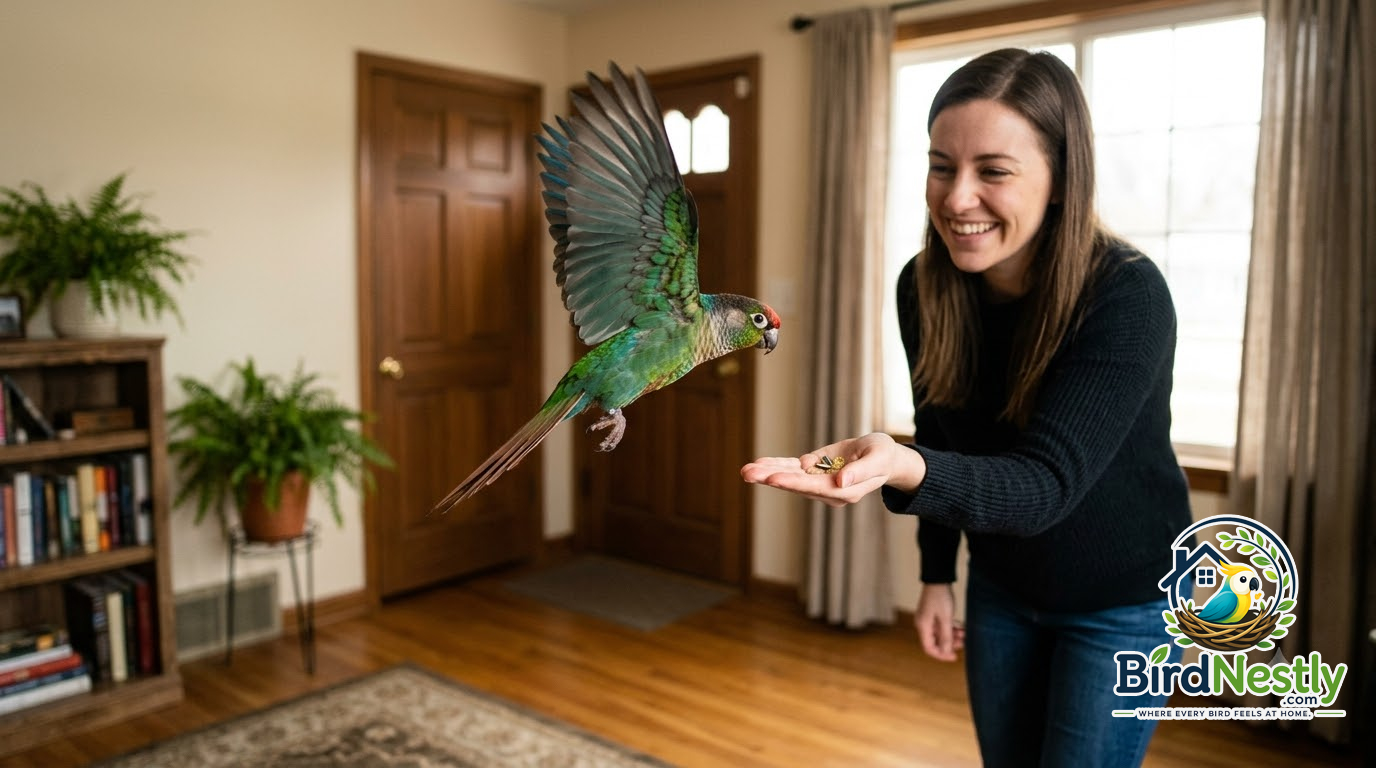
Once you have chosen a first word, use it regularly. Parrots learn by hearing sounds again and again, so consistency matters more than trying to teach a large number of words at once.
Say the word in a clear, natural voice. Keep the same pronunciation each time you practice. Speak close enough for your parrot to hear you clearly, but avoid getting too close if your bird becomes uncomfortable.
A short session can be as simple as:
- Get your parrot’s attention.
- Say the chosen word clearly.
- Pause for a few seconds.
- Give your bird a chance to respond.
- Praise or reward any attempt to copy the sound.
- Repeat several times.
- End the session while your parrot is still interested.
Do not keep repeating the word without giving your bird a chance to respond. The pause is important because it gives your parrot an opportunity to process the sound and try to copy it.
Your parrot may not produce anything that sounds like the word at first. You might hear a different sound, a quiet mumble, or only part of the word. These early attempts are worth encouraging.
With regular practice, those sounds may gradually become clearer.
4. Reward Your Parrot When It Tries
A small reward can make speech training much more interesting for your parrot. The reward should come immediately after the behavior you want to encourage.
For example, suppose you are teaching the word “hello.” Your parrot makes a sound that resembles part of the word. Praise the bird right away and offer a tiny piece of a favorite treat.
The timing matters because your parrot needs to connect the reward with its attempt.
You can use:
- A small food treat
- Verbal praise
- A favorite toy
- Gentle attention
- A short play session
Food often works well during early training, but not every parrot is motivated by the same thing. Pay attention to what your bird enjoys most.
Do not wait for perfect pronunciation before giving a reward. If your parrot only produces part of the word, that can still be a useful step.
As the sound becomes closer to the target word, continue rewarding it. Later, you can gradually reduce food rewards while continuing to praise your bird.
The goal is to make talking an enjoyable activity rather than something your parrot feels forced to do.
5. Use Words in Everyday Situations
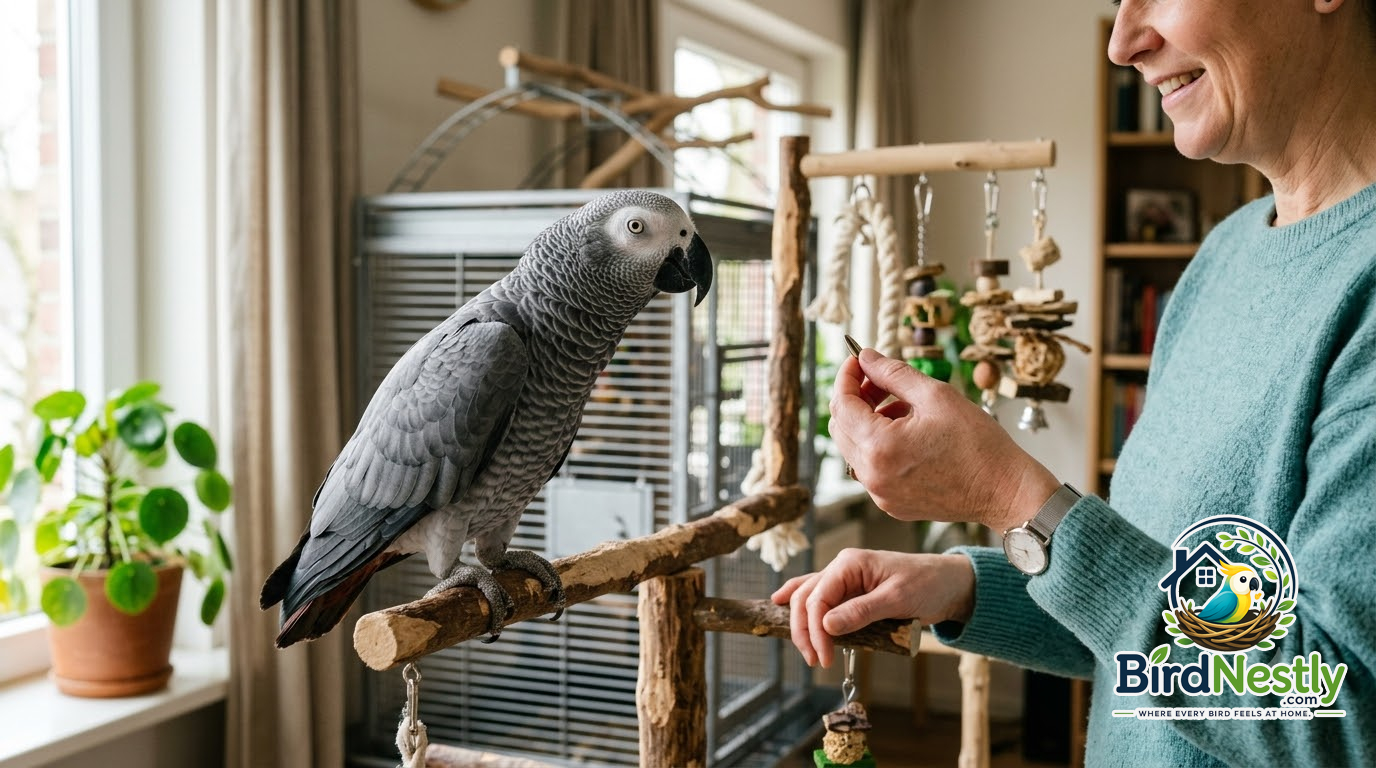
Your parrot does not need to sit through formal training every time it hears a new word. Everyday situations can provide plenty of opportunities for learning.
Try connecting certain words with things that happen regularly.
For example:
- Say “Good morning” when you uncover the cage in the morning.
- Say “Hello” when you enter the room.
- Say “Food” before placing the food bowl down.
- Say “Good bird” when your parrot responds correctly.
- Say “Bye” whenever you leave the room.
Using the same word in the same situation helps your parrot hear a clear connection between the sound and what is happening.
Your tone also matters. Speak naturally rather than shouting the word repeatedly. A calm, friendly voice is easier to use throughout the day and keeps interaction pleasant.
You can also talk to your parrot during normal activities. Tell it what you are doing, greet it, or repeat familiar phrases. Your bird may eventually begin copying sounds that it hears frequently.
6. Keep Training Sessions Short
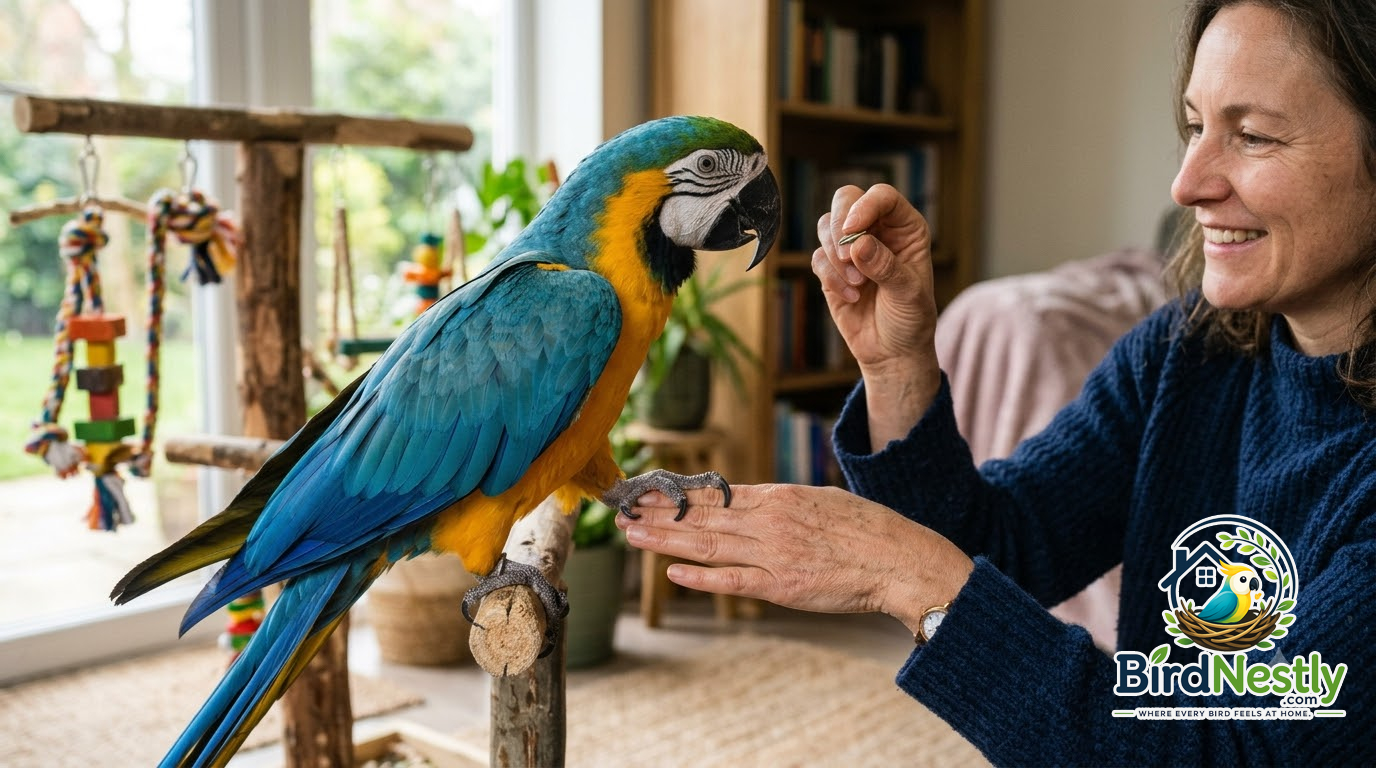
Parrots can lose interest when training goes on for too long. A short session that ends on a positive note is usually better than continuing until your bird becomes bored.
Start with around 5–10 minutes at a time. Depending on your parrot, you may be able to practice several times throughout the day.
Watch your bird’s behavior during each session. If it turns away, moves to another perch, stops accepting treats, becomes distracted, or appears irritated, give it a break.
There is no need to force your parrot to continue.
You can also finish immediately after a good attempt. For example, if your bird makes its clearest attempt at saying the target word, reward it and end the session. This leaves the training associated with a positive experience.
Regular practice is more important than long sessions. A few minutes of focused interaction each day can give your parrot many opportunities to hear and practice the same word.
7. Give Your Parrot Time to Learn
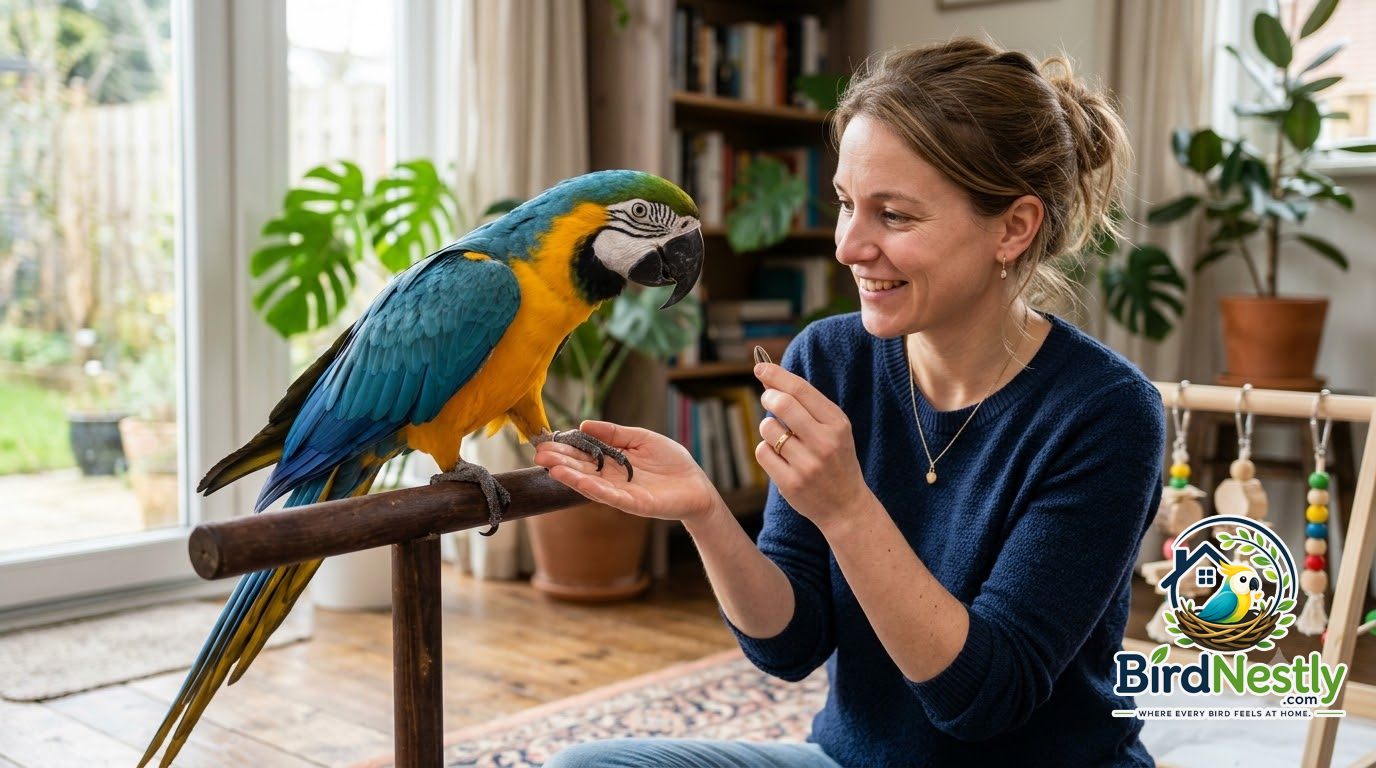
There is no fixed amount of time it takes for a parrot to start talking. Some birds begin copying sounds relatively quickly, while others need much longer before they produce a recognizable word.
Do not compare your parrot with another bird. Even two parrots of the same species can have very different personalities and learning speeds.
Continue using the same word and give your bird regular opportunities to hear it. If your parrot makes small attempts, keep encouraging those sounds rather than immediately moving on to another word.
Progress may look like:
Listening → making sounds → copying part of a word → clearer pronunciation → saying the word independently
Some parrots may spend a long time at one stage before moving forward.
Age can also play a role, but an older parrot is not automatically unable to learn new words. An adult bird may still learn through regular interaction and practice.
The most important thing is to avoid turning speech training into a source of stress. Your parrot does not need to become a great talker for training to be worthwhile. Spending time together, responding to your bird, and encouraging communication can strengthen your relationship even when spoken words develop slowly.
8. Teach New Words One at a Time
Once your parrot can say the first word reasonably well, you can introduce another one.
Avoid adding several new words at once. Your bird needs enough repetition to recognize each sound before moving on.
For example, if your parrot has learned “hello,” you might introduce “good bird” next. Continue practicing the first word while gradually adding the second.
You can divide your practice into short sessions:
Morning: “Hello”
Afternoon: “Good bird”
Evening: Review both words
Keep using familiar words during everyday activities so your parrot continues hearing them naturally.
When your bird learns a new word, reward attempts just as you did with the first one. Over time, you can build a small vocabulary without overwhelming your parrot.
Some parrots may also combine sounds they have learned and produce phrases that you did not specifically teach. This can happen when they hear the same words repeatedly in different situations.
9. Why Won’t My Parrot Talk?
A parrot that does not talk is not necessarily doing anything wrong. Some birds simply have little interest in copying human speech, while others take a long time to begin.
Before changing your training routine, look at a few basic factors.
Your parrot may not be interested yet
Some parrots pay more attention to sounds than others. If your bird ignores a particular word, try a different short word or phrase that it hears often.
The word may be too difficult
Long phrases and complicated sounds can be difficult for a beginner. Start with short words and move to longer phrases only after your parrot becomes comfortable copying sounds.
Training may not be consistent
Using one word for a few days and then switching to another can slow progress. Give your parrot enough time with one word before introducing something new.
Your bird may be distracted
Televisions, loud conversations, other pets, or activity around the room can make it difficult for your parrot to concentrate. Choose a quiet time for focused practice.
Your parrot may simply learn at its own pace
There is no guaranteed timetable for talking. Some parrots become vocal early, while others may take considerably longer.
Do not punish or become frustrated with a bird that does not speak. Talking is only one form of communication. Your parrot can still develop a strong bond with you through sounds, body language, and everyday interaction.
10. Avoid These Common Mistakes
Speech training can become harder when the sessions are rushed or inconsistent. A few common mistakes are worth avoiding.
Teaching too many words at once
Give your parrot enough time to practice one word before introducing several others.
Repeating a word without pauses
Your bird needs an opportunity to respond. Say the word, pause, and listen.
Training for too long
Once your parrot loses interest, continuing the session usually does not help. Keep practice short and end on a positive note.
Expecting perfect pronunciation
A parrot may pronounce a word differently from a person. Focus on progress rather than perfect speech.
Forcing your parrot to participate
Never chase, restrain, or frighten your bird in an attempt to make it talk. This can make your parrot less comfortable around you.
Changing the target word constantly
Choose a word and use it consistently. Once your bird has had enough practice, you can gradually introduce another.
Ignoring your parrot outside training
Some of the best opportunities for learning happen during normal daily interaction. Greeting your bird, talking while preparing its food, and using familiar phrases throughout the day can give it repeated exposure without making every interaction feel like a lesson.
Frequently Asked Questions
Can all parrots learn to talk?
No. Some parrots become excellent talkers, while others may only copy a few sounds or never use human words. Talking ability varies between individual birds, even within the same species.
What is the easiest word to teach a parrot?
Short, clear words such as “hello,” “hi,” or “bye” are good starting points. Choose a word that you can repeat naturally and consistently.
How long does it take to teach a parrot to talk?
There is no fixed timeline. Some parrots may begin copying sounds relatively quickly, while others can take weeks or months. Personality, species, age, environment, and regular practice can all affect progress.
How often should I teach my parrot to talk?
Short sessions of around 5–10 minutes are a good starting point. You can practice several times during the day as long as your parrot remains comfortable and interested.
How do I get my parrot to repeat words?
Choose one simple word, say it clearly, pause to give your bird a chance to respond, and reward attempts to copy the sound. Repeat the process regularly rather than introducing many words at once.
Should I reward my parrot for trying to talk?
Yes. Rewarding an attempt can encourage your parrot to keep practicing. You can use a small favorite treat, praise, or another reward your bird enjoys.
What if my parrot says the word incorrectly?
Continue encouraging it. Parrots often produce sounds that are only partly recognizable at first. Rewarding gradual improvement can help your bird become more consistent.
Can an older parrot learn to talk?
Yes. Older parrots can still learn new sounds and words. They may have established habits, but age alone does not mean that training is impossible.
Why won’t my parrot talk even after training?
Your parrot may need more time, may not be strongly interested in copying human speech, or may find the training environment distracting. Some parrots simply have limited interest in talking, so avoid forcing the behavior.
Should I teach my parrot several words at once?
It is usually easier to begin with one word. Once your parrot becomes comfortable with that word, gradually introduce another while continuing to review the words it already knows.


Write Your Review
No reviews yet. Be the first to share your experience!