

Teaching a parrot to come when called can make everyday handling much easier. It can also give your bird a useful way to return to you when it moves to another perch or flies a short distance across the room.
Recall training should start in a quiet, familiar place where your parrot feels comfortable. Begin with very short distances and reward your bird whenever it moves toward you after hearing the recall cue. As your parrot becomes more reliable, you can slowly increase the distance and add mild distractions.
The goal is not to make your bird respond perfectly on the first day. Build the behavior gradually and give your parrot plenty of successful attempts. A calm approach and consistent practice will usually produce better results than rushing through the training.
[wpsm_toplist]
1. Build Trust Before Recall Training
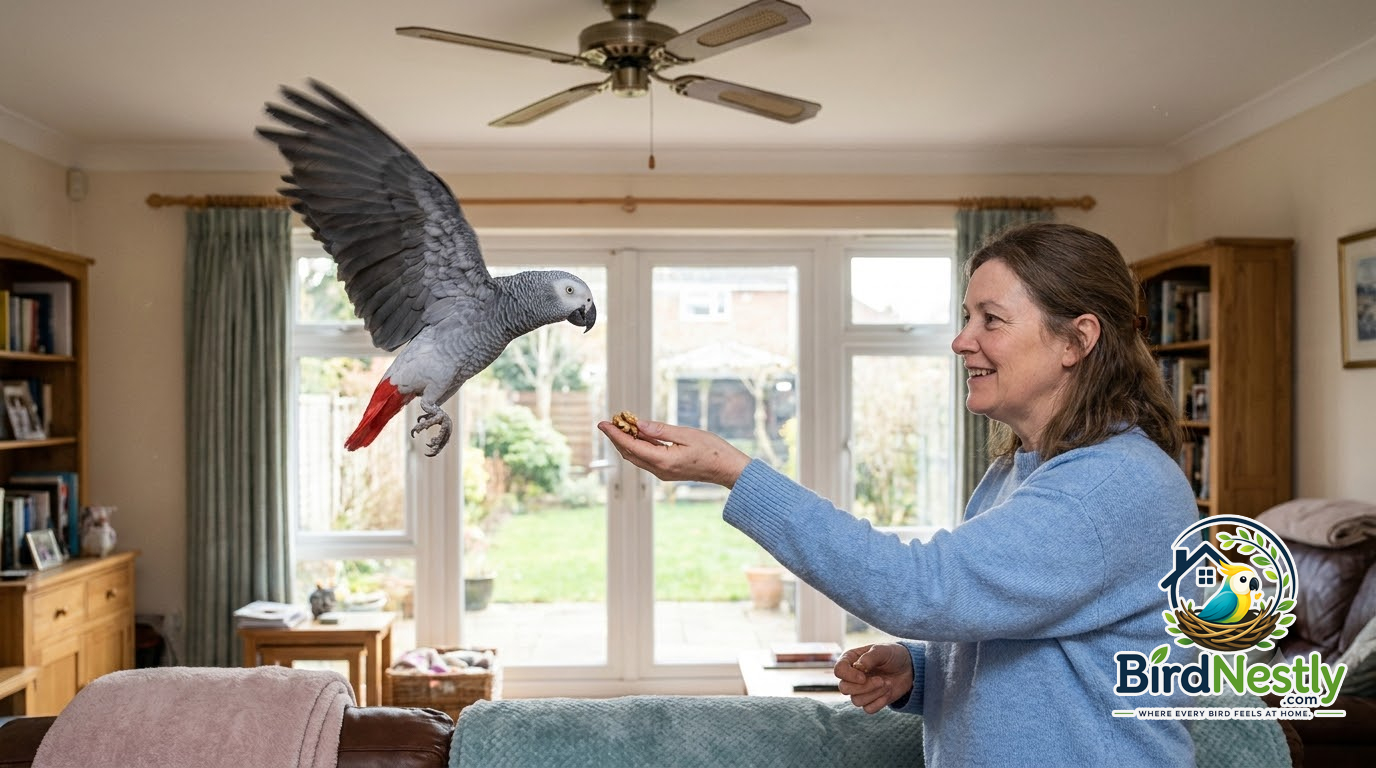
Your parrot needs to feel comfortable approaching you before you begin asking it to return from a distance. A bird that is nervous around your hands or frequently moves away from you may not be ready for recall practice.
Spend time with your parrot without making every interaction a training session. Talk to it, offer suitable treats, and allow it to approach you at its own pace.
You can also practice simple behaviors such as stepping onto your hand. When your parrot willingly steps up and remains relaxed, reward it immediately. This helps create a positive connection between coming toward you and receiving something enjoyable.
Pay attention to your bird’s body language. If it becomes tense, moves away, or shows signs that it wants more space, stop and give it a break.
Trust is especially important when training a bird to fly toward you. Your parrot should see you as a safe place to return to, not someone who will chase or grab it.
For basic training techniques, you can also refer to How to Train a Parrot.
2. Choose a Clear Recall Cue
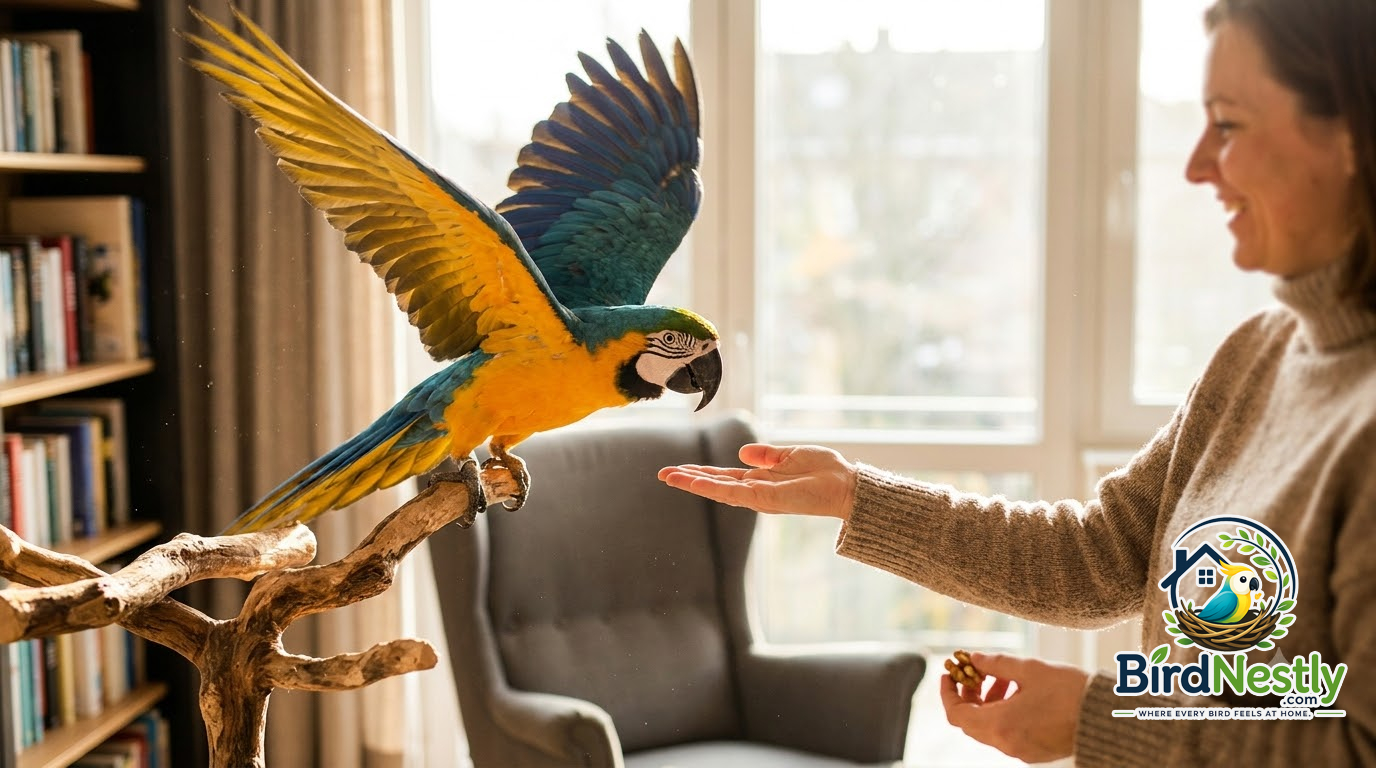
Pick one short word or sound that you will use whenever you want your parrot to come to you.
A simple cue such as:
- “Come!”
- “Here!”
- “Come here!”
can work well.
You can also use a consistent whistle or another short sound if your parrot responds particularly well to it.
The important thing is to keep the cue consistent. Avoid using several different phrases for the same behavior. Your parrot needs to learn that one particular sound means it should move toward you.
Start when your bird is already close to you. Hold out your hand or stand near a familiar perch, say the cue clearly, and encourage your parrot to move toward you.
When it does, reward it immediately.
At this stage, you are not testing how far your parrot can fly. You are simply teaching the meaning of the cue.
Repeat the exercise several times, but keep the session short. Once your bird begins responding reliably at close range, you can move on to slightly greater distances.
3. Start Recall Training at a Very Short Distance
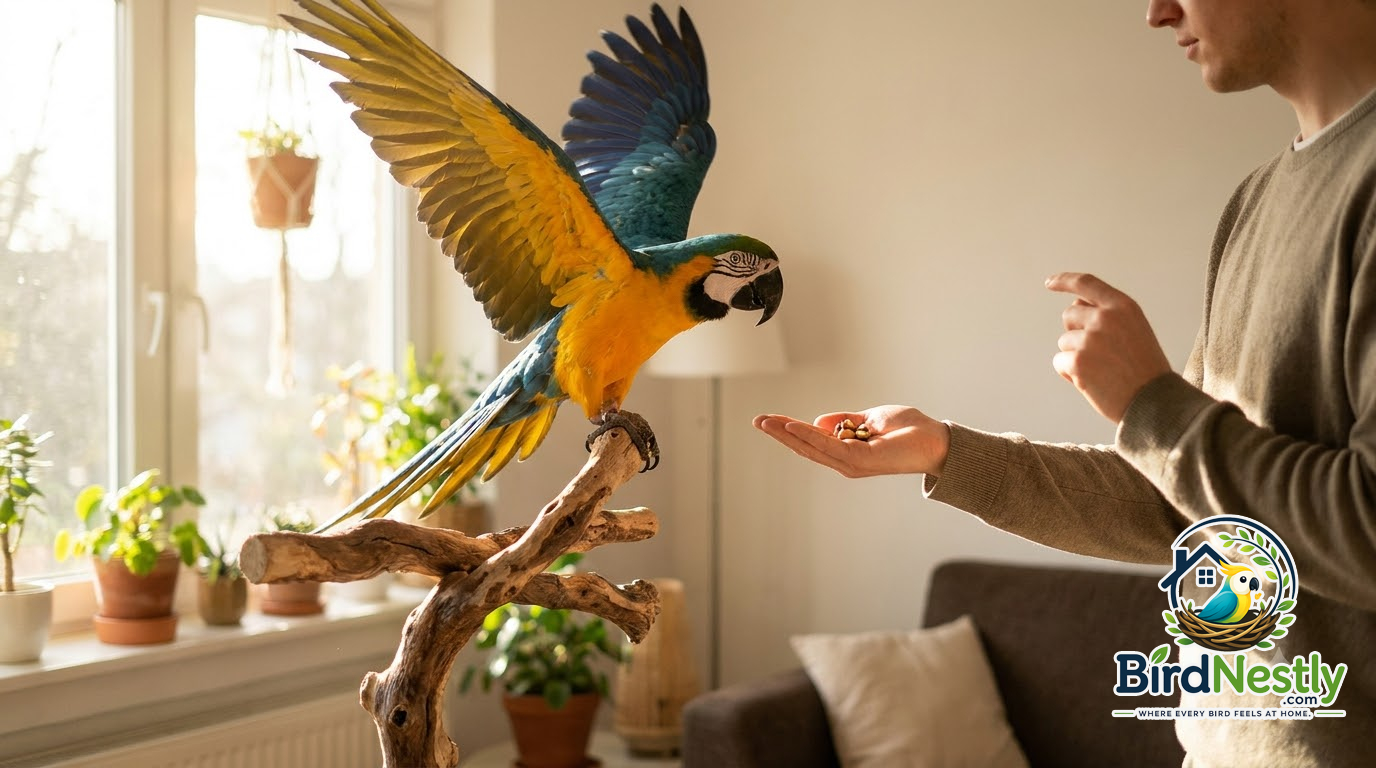
Once your parrot understands the recall cue, begin with a distance where success is almost guaranteed. Place your bird on a familiar perch and stand only a short distance away.
Hold out your hand and use the recall cue once.
If your parrot walks, hops, or flies toward you, reward it as soon as it reaches your hand.
At first, even a single step in your direction is worth encouraging. Your bird does not need to fly across the room immediately.
A simple training sequence looks like this:
Perch → recall cue → parrot moves toward you → reward
Repeat this several times, then give your bird a break.
If your parrot does not respond, do not keep repeating the cue. Move closer and make the exercise easier. You want your bird to experience frequent success rather than repeatedly hearing a command it cannot yet follow.
As your parrot becomes comfortable, you can gradually move farther away.
For example:
1–2 feet → 3 feet → 5 feet → greater distances
Only increase the distance when your bird is responding reliably at the current level.
4. Reward Every Successful Recall
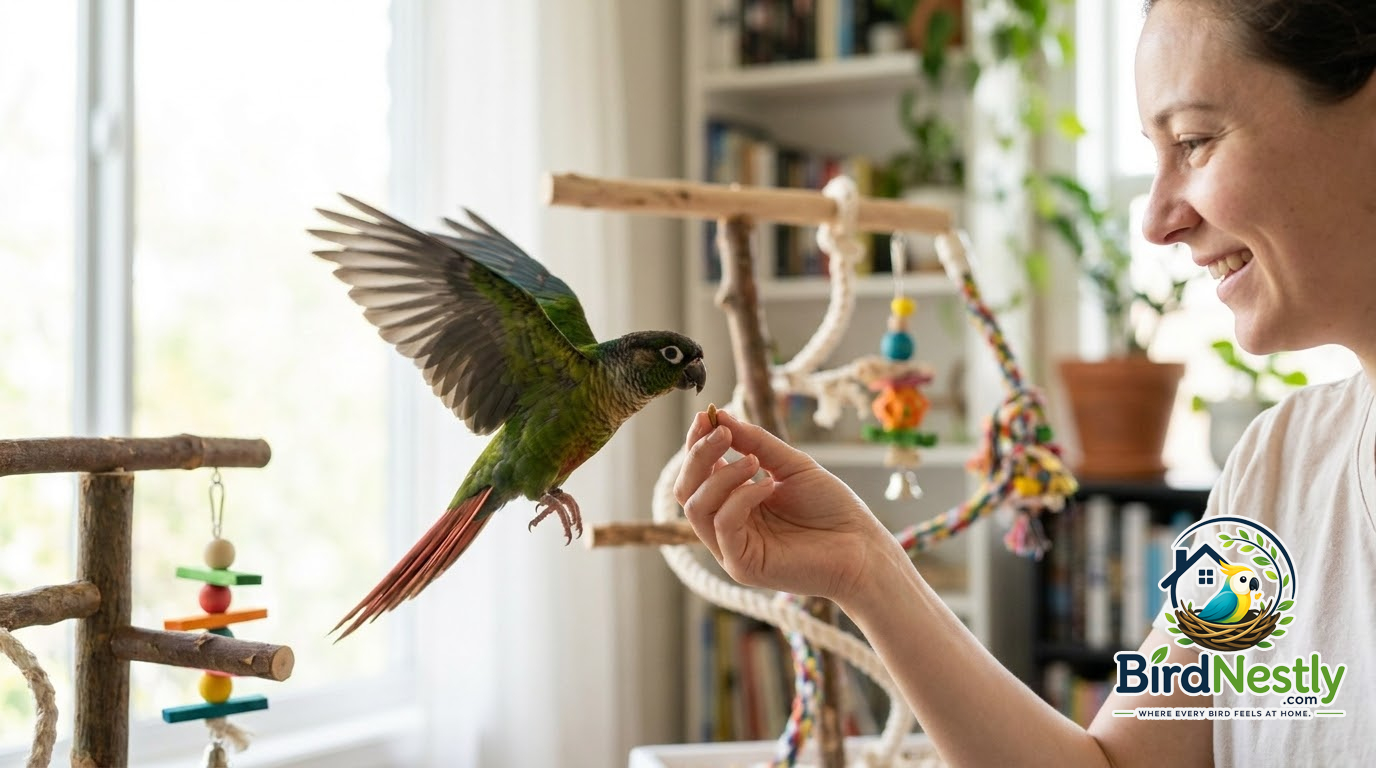
A good reward gives your parrot a reason to come back to you.
Choose something your bird genuinely enjoys. A tiny favorite treat often works well, but praise, attention, or a short play session can also be useful depending on what motivates your parrot.
The timing of the reward is important. Give it immediately after your parrot reaches you rather than several seconds later.
For example:
“Come!” → parrot flies to your hand → immediate praise and treat
This helps your bird connect the return with the positive experience.
During the early stages, reward every successful recall. Your parrot should quickly learn that responding to the cue is worthwhile.
As the behavior becomes more reliable, you can gradually vary the rewards. Sometimes give a treat, sometimes praise, and sometimes allow your bird to return to its favorite perch or continue playing.
One important rule is to avoid making every recall signal the end of something enjoyable. Occasionally call your parrot, reward it, and then let it go back to what it was doing.
That way, your bird is less likely to learn that coming to you always means playtime is over.
5. Gradually Increase the Distance
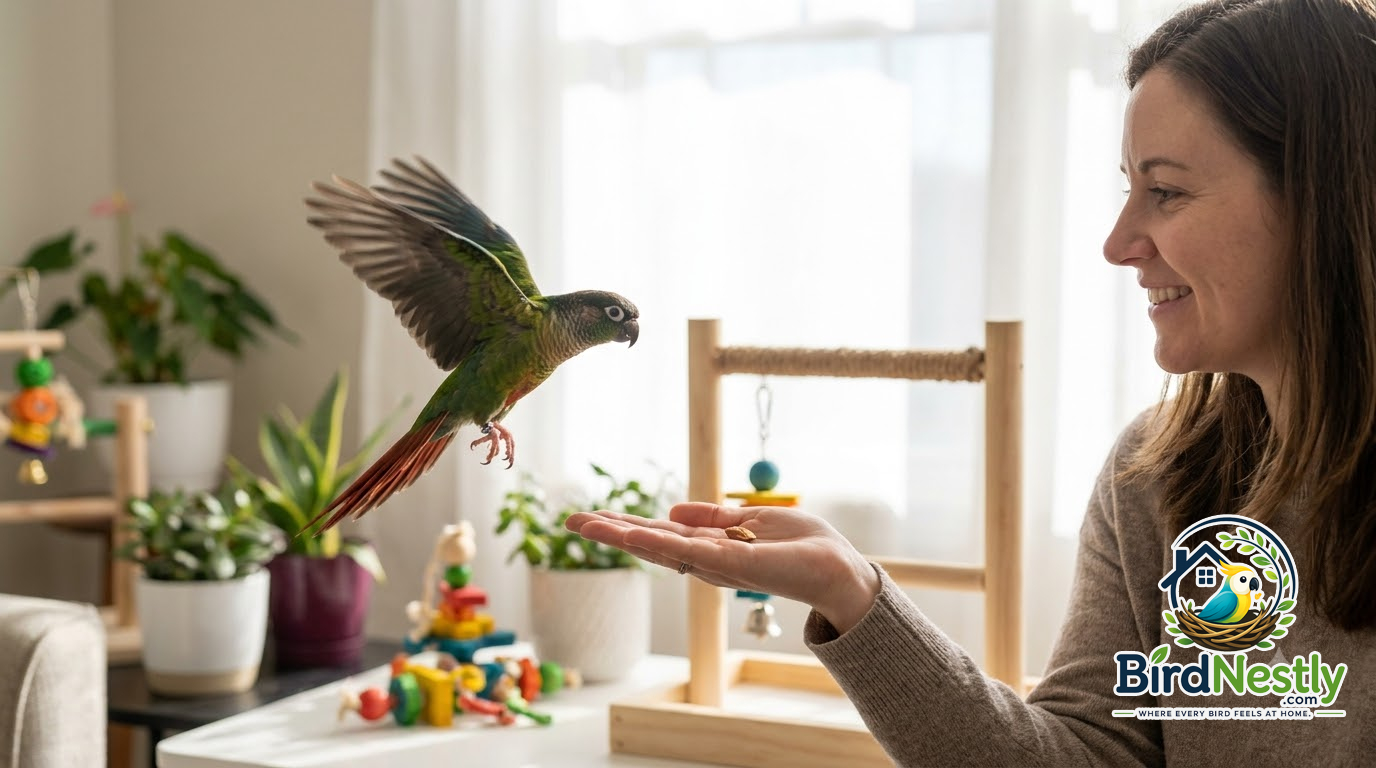
Once your parrot reliably comes to you from a short distance, begin moving farther away. Increase the distance slowly rather than making a large jump.
For example, if your bird responds well from two feet away, try three or four feet next. When that becomes easy, move farther away again.
Each successful attempt should be followed by a reward.
If your parrot suddenly stops responding, do not keep increasing the distance. Return to the last distance where your bird was successful and practice there again.
Your parrot may need several sessions before it is comfortable with a new distance. That is normal.
You can also change the starting position. Have your bird recall from:
- A tabletop perch
- The back of a chair
- A play stand
- Another familiar perch
- Your hand
Keep the surroundings safe and free from obstacles, especially when your parrot is flying.
6. Practice in Different Rooms
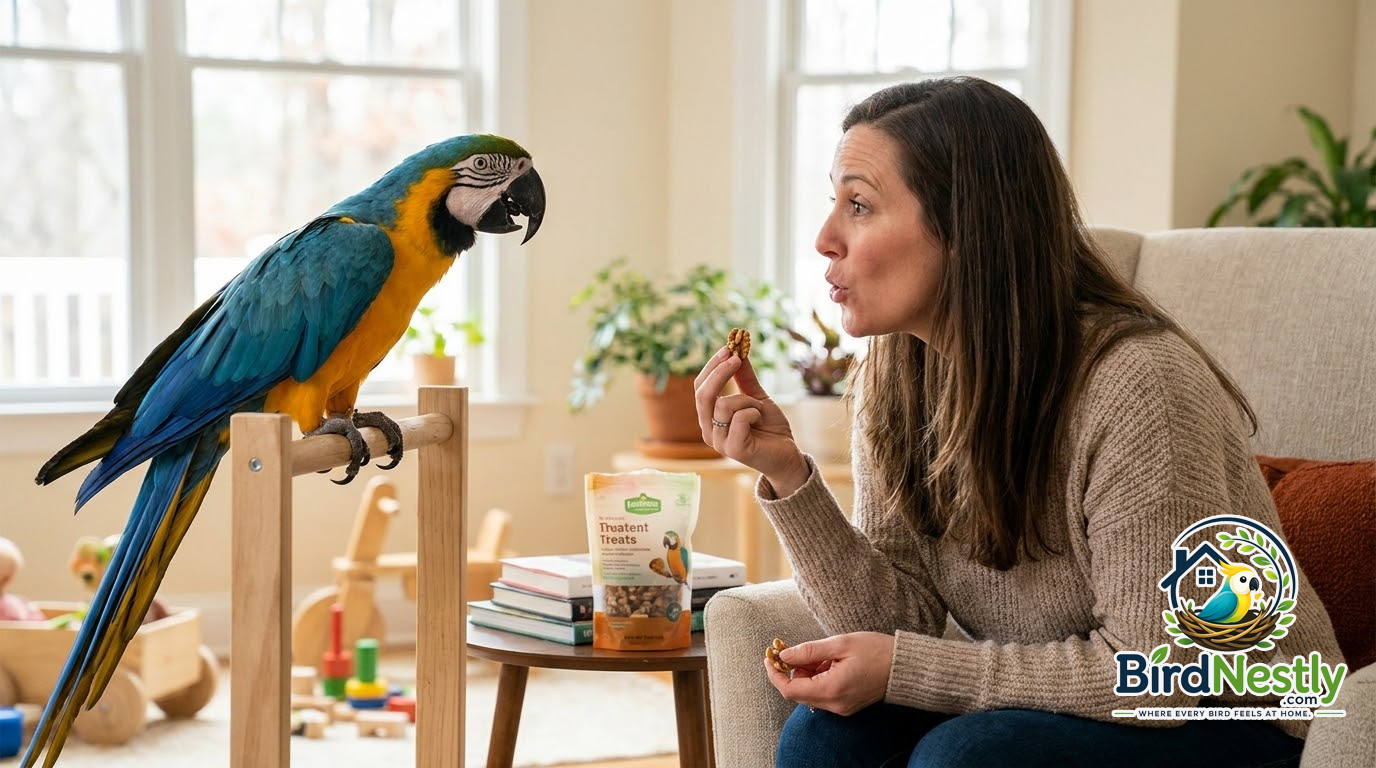
A parrot that responds perfectly in one room may not respond as well somewhere else. Different surroundings can change how much attention your bird gives to you.
Once your parrot has a reliable recall in its usual training area, practice in another familiar room.
Start again at a short distance.
Use the same recall cue and reward your bird when it comes to you. Gradually increase the distance as before.
You can also introduce mild distractions, such as a toy or another familiar person in the room. Keep the distractions limited at first.
If your parrot becomes distracted and ignores the cue, make the exercise easier rather than calling repeatedly.
The aim is to help your bird understand that the recall cue means the same thing wherever you are.
Before allowing your parrot to fly freely around the home, make sure windows and doors are closed and remove anything that could cause injury. Ceiling fans should also be turned off during flight practice.
7. Teach Your Parrot to Recall From Different Perches
Once your parrot can reliably come to you from one familiar location, practice from different perches around the room.
Place your bird on a safe perch, move a short distance away, and give the same recall cue. When your parrot comes to you, reward it immediately.
Changing the starting point helps prevent your bird from learning that the cue only works from one particular perch.
You can practice from:
- A play stand
- The top of a cage
- A natural branch perch
- A chair back
- Another safe elevated surface
Keep the distance short when introducing a new location. Your parrot may already understand the recall cue, but the unfamiliar position can still make the exercise more difficult.
Once your bird responds consistently, gradually increase the distance.
8. Add Distractions Slowly
A reliable recall should eventually work even when something else has your parrot’s attention. However, distractions should be introduced gradually.
Start with something minor, such as a familiar toy placed several feet away. Give your recall cue and reward your parrot for choosing to come to you.
Later, you can practice when there is more activity in the room.
Do not begin with strong distractions. Loud sounds, unfamiliar people, other animals, or exciting toys can make it much harder for your parrot to focus.
If your bird ignores the cue, reduce the distraction and return to an easier exercise.
The goal is to teach your parrot that returning to you is always worthwhile, even when something else catches its attention.
This is also where patience becomes important. A bird that succeeds in a quiet room may need additional practice before responding reliably in a busy environment.
Frequently Asked Questions
What is parrot recall training?
Parrot recall training teaches a bird to return to its owner when it hears a specific word, whistle, or other consistent signal. Training usually begins at a very short distance and gradually becomes more difficult.
How do I teach my parrot to come when called?
Choose one clear recall cue and use it consistently. Start with your parrot only a short distance away. Give the cue, encourage your bird to come toward you, and reward it immediately when it reaches you.
What is the best recall command for a parrot?
There is no single command that works for every parrot. “Come,” “Here,” or “Come here” are simple choices. A consistent whistle or sound can also work well.
How long does parrot recall training take?
The time varies between individual birds. Some parrots learn the basic response relatively quickly, while others need weeks of regular practice. Short, consistent sessions are more useful than occasional long sessions.
How far away should I start recall training?
Start very close, often around 1–2 feet. Once your parrot responds reliably, gradually increase the distance. If your bird starts ignoring the cue, move closer again.
Should I reward my parrot every time it comes to me?
During the early stages, rewarding each successful recall helps your parrot understand that returning to you is a desirable behavior. As the response becomes reliable, you can vary the rewards.
What should I do if my parrot ignores the recall cue?
Do not repeatedly shout the cue. Move closer, reduce distractions, and try again. Your parrot may not yet be ready for that distance or level of distraction.
Can I train my parrot to recall in different rooms?
Yes. Once your bird responds reliably in its normal training area, practice in other safe rooms. Start at a short distance and gradually increase the difficulty.
Can recall training be used for outdoor free flight?
Indoor recall training is a useful foundation, but it does not automatically make outdoor free flight safe. Outdoor environments contain unpredictable distractions and hazards. Additional preparation and safety measures are necessary before considering outdoor flight.
How often should I practice parrot recall?
Short sessions of around 5–10 minutes can be a good starting point. Practice regularly, but stop when your parrot becomes tired, distracted, or frustrated.


Write Your Review
No reviews yet. Be the first to share your experience!