

Clicker training can be a simple way to teach a parrot new behaviors without forcing it to cooperate. The small clicking sound gives your bird a clear signal that it has done something correctly, followed by a reward.
The process starts with something very easy. Before asking your parrot to perform a trick or follow a command, you first need to help it understand what the click means. Once that connection is clear, you can use the clicker to teach behaviors such as stepping onto your hand, touching a target, coming when called, or turning around.
Every parrot is different. Some birds become interested in the clicker quickly, while others need more time to become comfortable with the sound. Keep the sessions relaxed and pay attention to how your bird responds.
[wpsm_toplist]
1. Choose the Right Clicker for Your Parrot
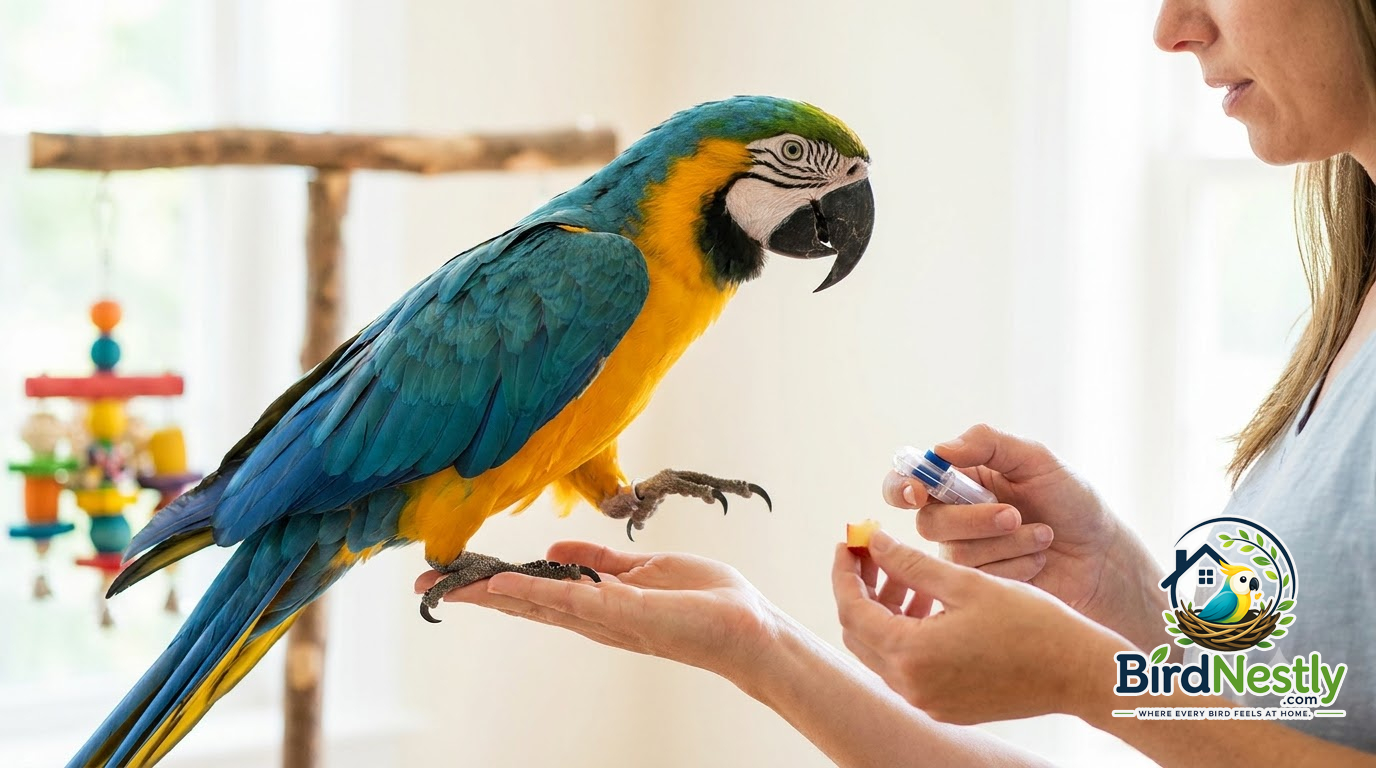
A clicker is a small device that makes a short, distinct clicking sound when you press it. You do not need an expensive one to begin training.
The most important thing is the sound. It should be clear enough for your parrot to hear but not so loud that it makes the bird nervous.
Some parrots are sensitive to sudden noises. When introducing a new clicker, keep it a reasonable distance from your bird and watch its reaction. If your parrot suddenly moves away, becomes tense, or appears frightened, the sound may be too loud or the clicker may be too close.
A clicker that is easy to hold and press with one hand is also helpful. You will often need one hand for the clicker and the other for a treat or training target.
Keep your rewards ready before starting. Small pieces of a favorite food work well because your parrot can eat them quickly and return to training.
You do not need a large supply of treats. A few small pieces are enough for a short session.
2. Teach Your Parrot What the Click Means
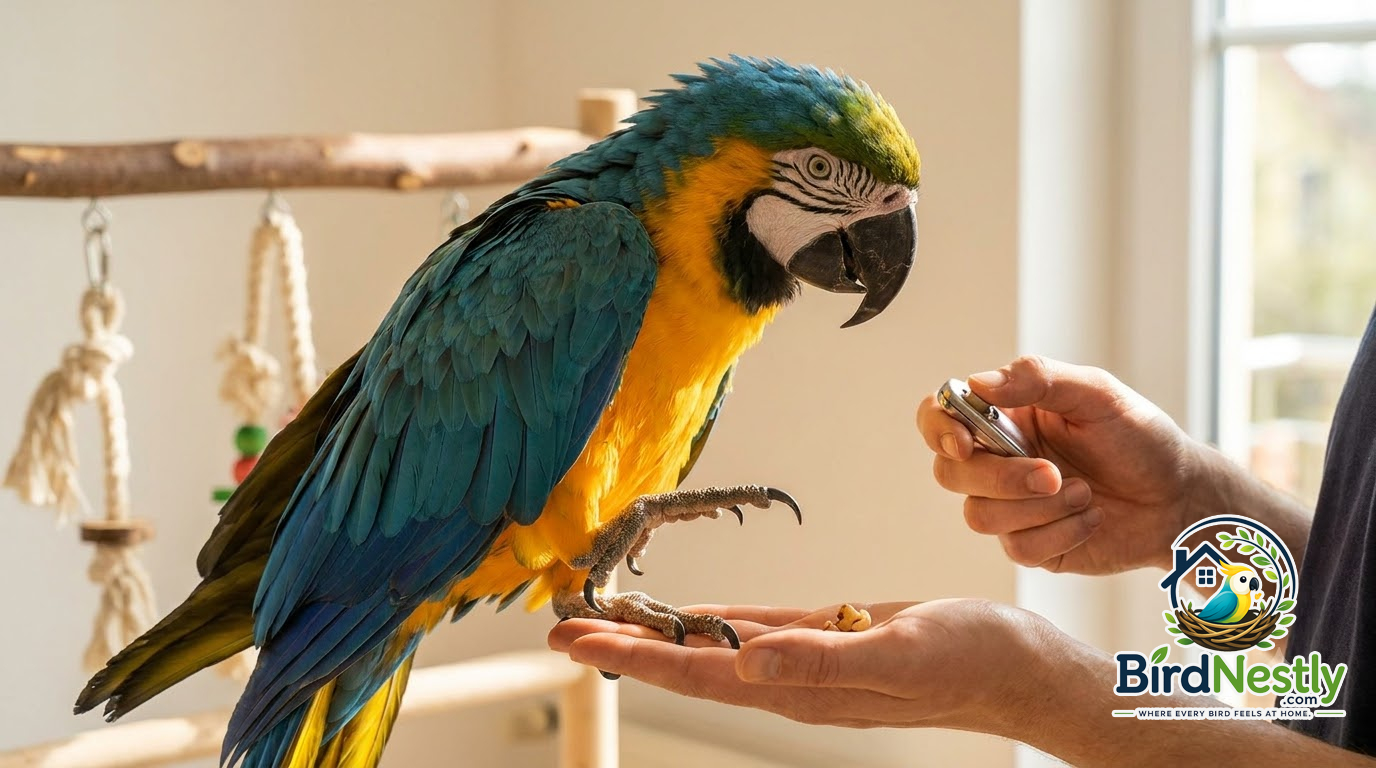
Before using the clicker to teach a specific behavior, help your parrot understand that the sound is followed by something good.
Start when your bird is calm and comfortable.
Press the clicker once.
Immediately give your parrot a small treat.
Then wait a moment and repeat:
Click → Treat
Continue this several times.
At this stage, do not ask your parrot to step up, fly to you, touch anything, or perform a trick. The only goal is to create a clear connection between the clicking sound and the reward.
Watch your bird’s reaction. After several repetitions, your parrot may begin looking toward you immediately after hearing the click or waiting for the treat.
That is a good sign that the sound is starting to have meaning.
Keep the first session short. There is no need to spend a long time clicking and treating. A few minutes is enough.
If your parrot seems frightened by the sound, increase the distance between the clicker and the bird and make the sound softer. Give your bird time to become comfortable before continuing.
Once your parrot hears the click and expects a reward, you can begin using it to mark specific behaviors.
3. Start With a Simple Behavior
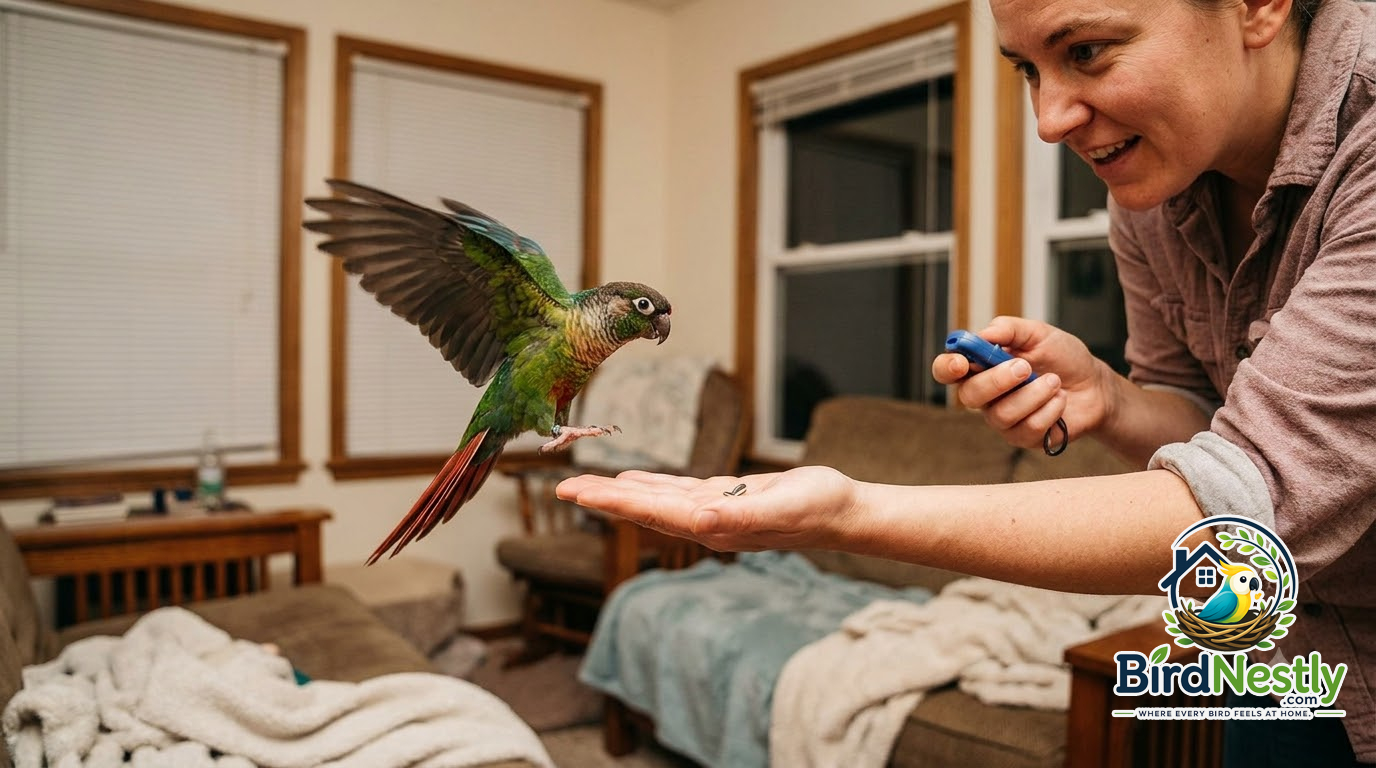
Once your parrot understands that the click is followed by a reward, you can begin teaching a behavior.
Start with something your bird can do naturally, such as looking toward you, moving toward your hand, touching an object, or stepping onto a perch.
Do not begin with a complicated trick. The first few exercises should be easy enough that your parrot can succeed several times.
For example, hold your hand near your parrot. If the bird moves toward your hand or places one foot on it, click immediately and give a small treat.
The sequence should be:
Desired behavior → Click → Treat
Your timing matters. The closer the click is to the exact moment your parrot performs the behavior, the easier it is for your bird to understand what earned the reward.
After several successful repetitions, your parrot may begin offering the behavior more often.
Keep your sessions short and stop while your bird is still interested.
4. Use the Click at the Right Moment
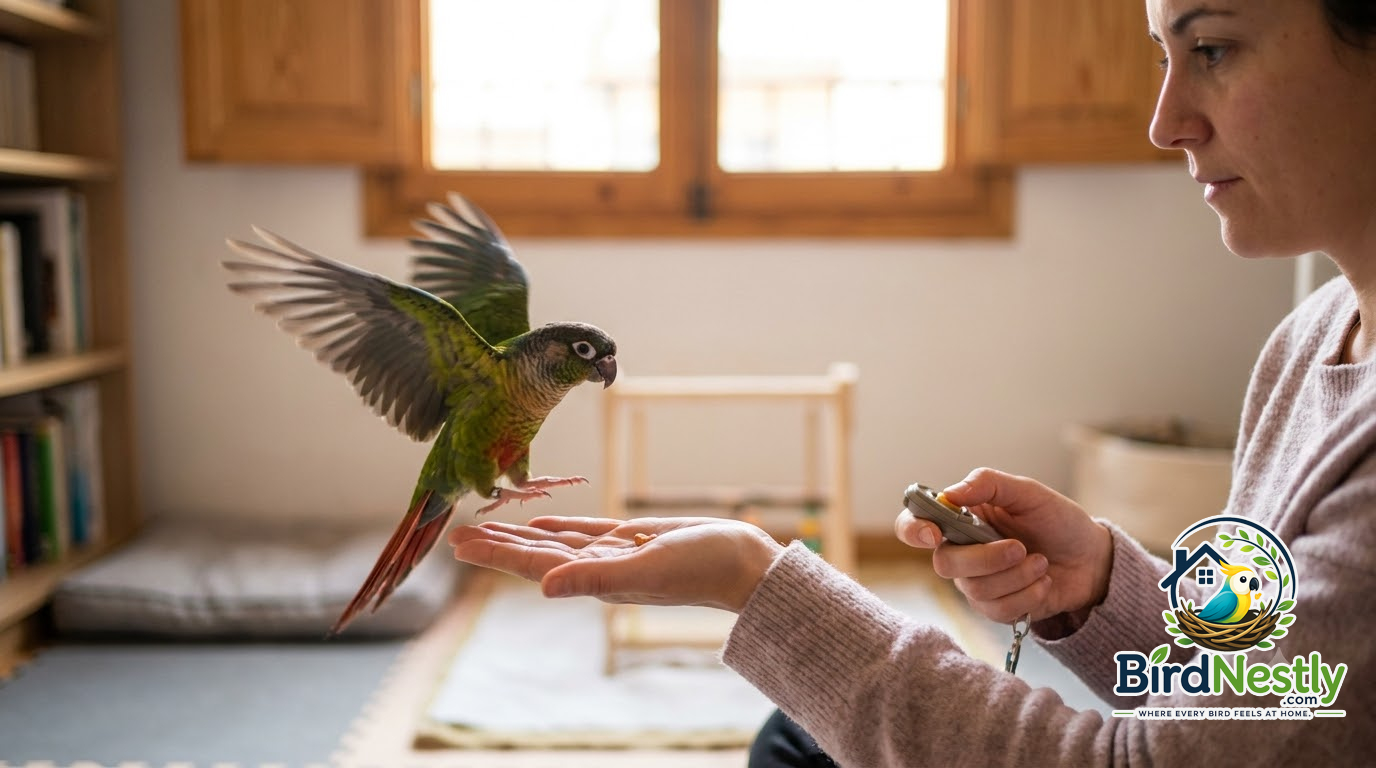
The click should mark the exact behavior you want your parrot to repeat.
Suppose you are teaching your bird to step onto your hand. Your parrot places one foot on your hand, then the second foot follows.
You can click as soon as the bird completes the behavior you are trying to teach, followed immediately by the reward.
Avoid clicking several seconds after the behavior. Your parrot may not understand what the click was meant to mark.
The same principle applies to other behaviors.
If you are teaching your parrot to touch a target:
Parrot touches target → Click → Treat
If you are teaching recall:
Parrot comes toward you → Click → Treat
If you are teaching a turn:
Parrot completes the turn → Click → Treat
You do not need to click continuously throughout the exercise. One clear click at the right moment is enough.
With practice, you will become better at watching your parrot and marking the behavior precisely.
5. Keep the Rewards Small and Quick
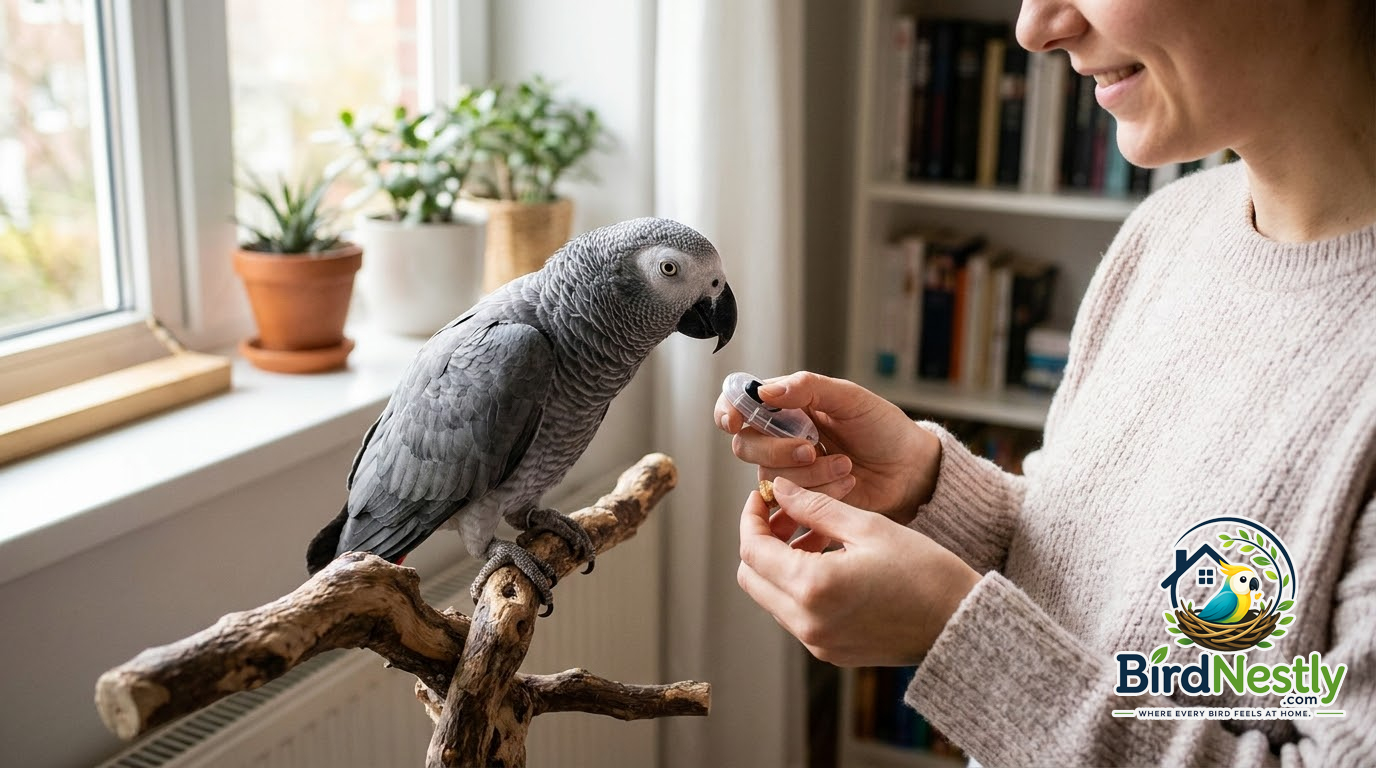
The reward is an important part of clicker training. Your parrot should receive it soon after the click so it can connect the two events.
Use a treat that your bird already enjoys. Break it into very small pieces so your parrot can eat it quickly and return its attention to you.
Good rewards depend on the individual bird. Some parrots may work eagerly for a tiny piece of fruit, while others prefer a favorite seed or another food they rarely receive.
You can also use non-food rewards once you know what motivates your parrot. Praise, attention, a favorite toy, or a short play session may work for some birds.
During early training, food is often the easiest reward to use because the connection is quick and clear.
Avoid giving a large piece of food after every click. Your bird may become full before the session is over, and the training can lose its rhythm.
6. Teach the Step-Up Behavior With a Clicker
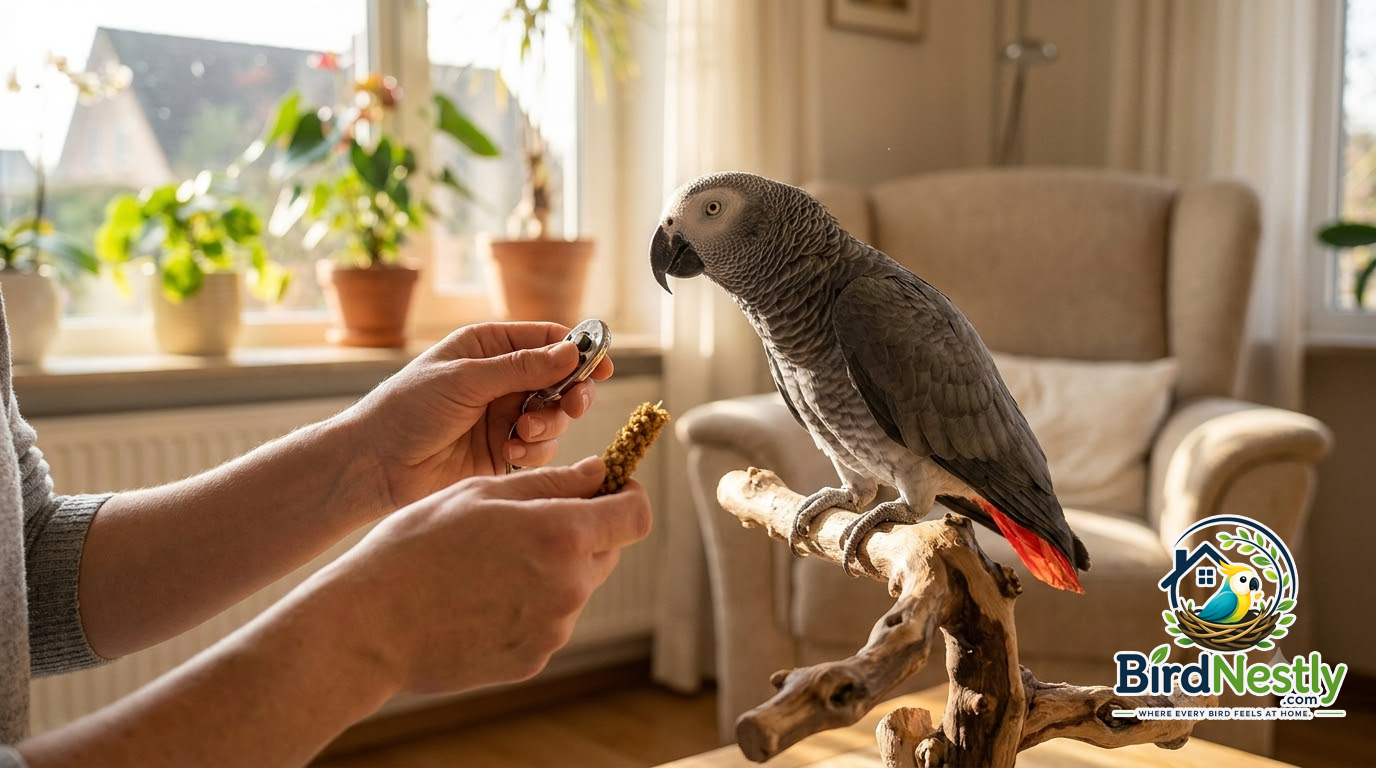
Step-up is a useful behavior to teach because it makes handling your parrot easier.
Begin when your bird is relaxed. Hold your hand or a suitable perch near your parrot without forcing it forward.
Wait for the behavior you want.
If your parrot leans toward your hand, places one foot on it, or steps fully onto it, click at the appropriate moment and give a reward.
Repeat the exercise several times.
Once your bird understands that stepping onto your hand leads to a click and reward, you can introduce a verbal cue such as “step up.”
The progression can look like this:
“Step up” → parrot steps onto hand → click → treat
Keep the distance short and avoid pushing your hand against your bird’s body. If your parrot backs away or becomes uncomfortable, give it some space and make the next attempt easier.
For a broader approach to teaching different behaviors, you can also read How to Train a Parrot.
7. Use Clicker Training to Teach Recall
Once your parrot understands the basic idea of clicker training, you can use the clicker to strengthen recall.
Start at a very short distance. Place your bird on a familiar perch and stand nearby.
Use your recall cue, such as “Come!” When your parrot moves toward you and reaches your hand, click immediately and give the reward.
The basic pattern is:
Recall cue → parrot comes to you → click → treat
Begin with a distance where your bird is very likely to succeed. As the response becomes reliable, gradually move farther away.
Do not keep calling if your parrot ignores the cue. Instead, move closer and make the exercise easier.
You can also practice in different rooms once your bird understands the behavior. Keep the surroundings safe and free from hazards during flight practice.
For a more detailed guide to this type of training, see Parrot Recall Training.
8. Keep Clicker Training Sessions Short
A parrot can lose interest quickly if a training session goes on for too long. Short sessions are easier to manage and give your bird a chance to finish while the experience is still enjoyable.
Start with around 5–10 minutes.
During that time, you may only complete a few successful repetitions. That is fine. The quality of each repetition matters more than trying to fit as many exercises as possible into one session.
Watch your parrot closely. If it starts walking away, stops taking treats, becomes distracted, or appears frustrated, end the session.
You can always practice again later.
It is also useful to finish after a successful attempt. For example, if your parrot performs the behavior particularly well, click, reward, and then stop for the day.
With regular practice, your bird can gradually become more confident and responsive without feeling pressured.
Frequently Asked Questions
Can you clicker train a parrot?
Yes. Many parrots can learn to associate a click with a reward and use that information to learn new behaviors. The process works best when the bird is comfortable with the sound and enjoys the reward.
How do I start clicker training my parrot?
Begin with click → treat. Do not ask your parrot to perform anything at first. Repeat the process several times until your bird starts expecting a reward after hearing the click.
How long should clicker training sessions last?
Around 5–10 minutes is a good starting point. Some parrots may prefer even shorter sessions. Stop when your bird loses interest or shows signs of stress.
What treats should I use for clicker training?
Use a small amount of a food your parrot particularly enjoys. The pieces should be small enough to eat quickly so your bird can return to training without a long interruption.
What if my parrot is scared of the clicker?
Move the clicker farther away and make the sound less intense. Give your bird time to become comfortable with it. Never repeatedly click close to a frightened parrot.
When should I click during training?
Click immediately when your parrot performs the behavior you want to encourage. Follow the click with the reward. Good timing helps your bird understand exactly which behavior earned the reward.
Can I use clicker training to teach my parrot to step up?
Yes. Click when your parrot successfully steps onto your hand or perch, then give a reward. After your bird understands the behavior, you can add a verbal cue such as “step up.”
Can clicker training teach a parrot to come when called?
Yes. You can click when your parrot successfully returns to you after hearing the recall cue, then reward it immediately. Start at a short distance and gradually increase it.
Can clicker training help with parrot biting?
Clicker training can be useful for encouraging calm, desirable behaviors, but biting should first be understood rather than simply punished. Fear, stress, territorial behavior, and overstimulation can all contribute to biting.
Do I have to use treats forever?
No. Once your parrot reliably understands a behavior, you can gradually vary the rewards. Praise, attention, toys, or other enjoyable activities can become part of the reward system while treats are used less frequently.


Write Your Review
No reviews yet. Be the first to share your experience!