

[wpsm_toplist]
Mình viết lại theo đúng phong cách blog tự nhiên hơn, không dùng các mẫu câu thường gặp của AI như the moment, I realized, it only takes, the good news is, if you’re wondering,… Đồng thời chèn từ khóa chính một cách tự nhiên.
The Day My Parrot Discovered Watermelon
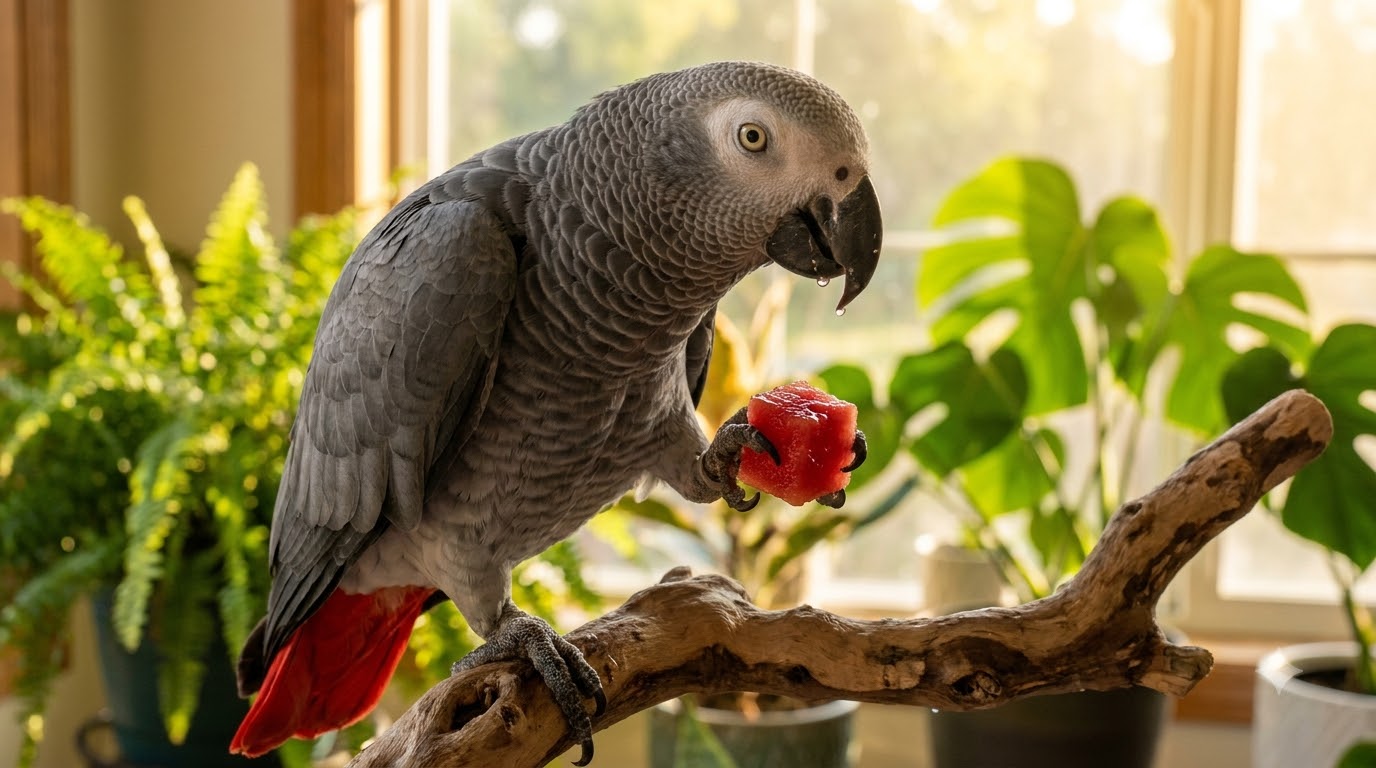
Every summer, there’s almost always a watermelon sitting on my kitchen counter. I buy one for the family, but before long the parrots notice it too. It’s funny how they seem to know whenever something colorful shows up in the kitchen. While I’m cutting thick red slices, there’s usually one curious little face watching from the cage, waiting to see whether a piece will end up in the food bowl.
The first time I shared watermelon, I nearly handed over a slice just as it was. Then I looked at it again. There were black seeds scattered through the middle, a thick green rind around the outside, and I paused for a second. Can parrots eat watermelon seeds and rind? It wasn’t something I’d ever thought about before, and I wasn’t going to guess with my birds.
After reading a little and talking with my avian vet, my routine changed. The sweet red flesh stayed, while the large black seeds and the tough green rind came off before breakfast. Now I don’t even think about it. It’s simply part of preparing fruit, just like washing an apple or peeling an orange.
One of my African Greys has a habit that still makes me smile. It always grabs the first piece with one foot, takes a few slow bites, and somehow ends up with watermelon juice all over its beak. Another bird only wants the softest part near the center and leaves the rest behind. Watching each parrot eat the same fruit in a completely different way is one of those little things that never gets old.
Those small moments are probably why watermelon keeps finding its way back onto the menu every summer. A few minutes spent removing the parts I don’t want the birds to eat is a small price to pay for seeing them enjoy one of their favorite seasonal treats.
What Parts of a Watermelon Can Parrots Eat?
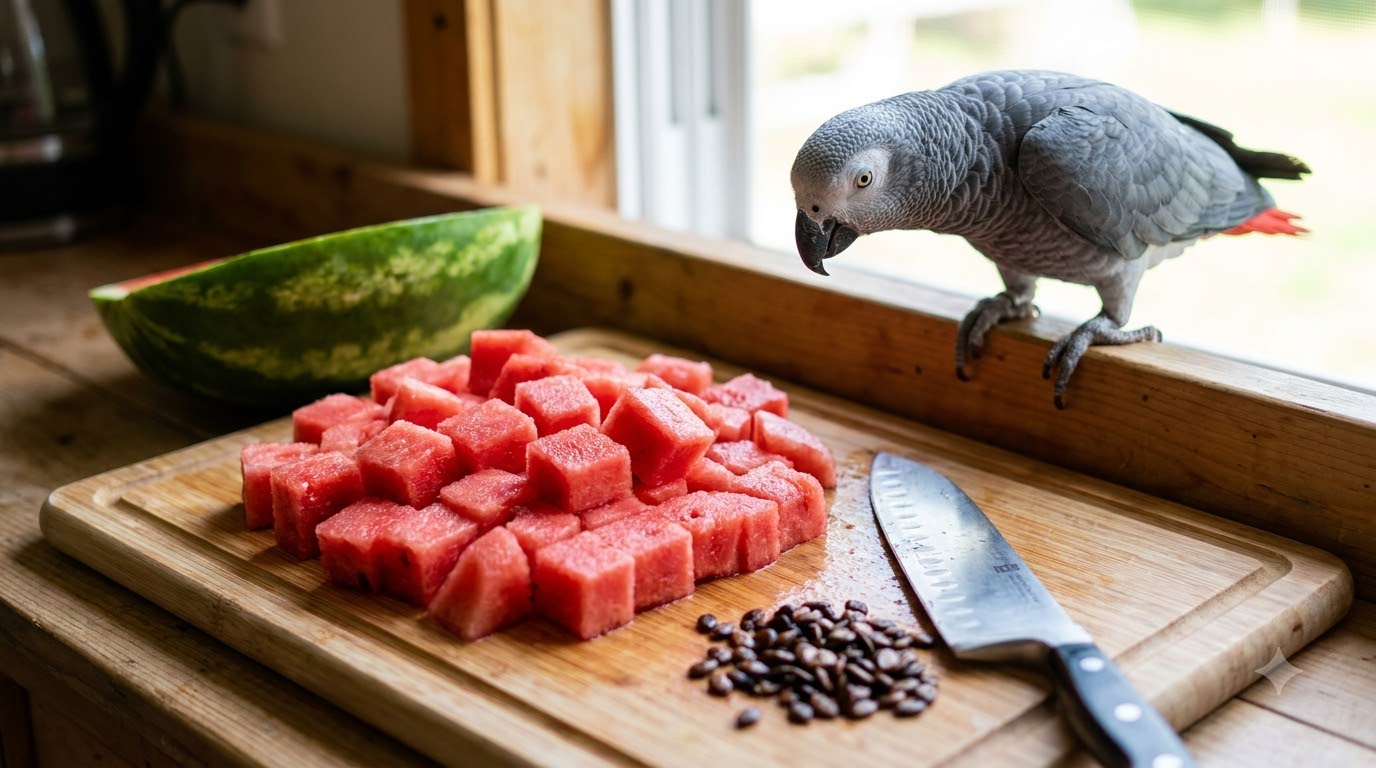
Whenever someone asks me “can parrots eat watermelon seeds and rind”, I usually answer by picking up a slice of watermelon instead of giving a long explanation. Looking at the fruit makes everything much easier to understand because each part is a little different.
The red flesh
The juicy red part is the only section that regularly goes into my parrots’ food bowls.
It’s soft, easy to bite, and full of water. On hot summer afternoons, my birds seem much more interested in watermelon than heavier fruits like bananas. They’ll often finish the watermelon first before coming back for the vegetables.
Watermelon is made up of about 90% water, which is one reason it feels so refreshing during warm weather. It also contains small amounts of vitamin A, vitamin C, and lycopene, the natural pigment that gives the fruit its bright red color.
The seeds
The seeds are the part that gets the most attention from bird owners.
Tiny white seeds are soft and immature. If one slips through while I’m cutting the fruit, I don’t worry too much.
The larger black seeds are different. I remove them before serving. They’re hard, don’t offer any real value in a pet parrot’s diet, and there’s simply no reason to leave them in.
One of my African Greys has a funny habit of digging through a slice of watermelon with its beak. If it finds a black seed, it doesn’t eat it. It picks it up, rolls it around for a few seconds, then drops it onto the bottom of the cage. After watching that happen a few times, I started removing every large seed before breakfast.
The rind
People often ask whether parrots can chew on the white part near the skin.
Some birds probably would if you offered it, but I don’t.
The thick green rind is tough, and even the pale white layer underneath isn’t something my birds seem interested in. I’d rather give them another piece of the soft red flesh than watch them struggle with something they’ll probably leave behind anyway.
There’s another reason I leave the rind out. Even after washing the outside of a watermelon, the skin is still the part that has been handled the most from the farm to the grocery store. Since the parrots enjoy the inside much more, I don’t see any advantage in serving the rind.
So when people ask “can parrots eat watermelon seeds and rind”, my answer is always simple: keep the sweet red flesh, remove the large black seeds, and leave the rind on the cutting board.
How I Serve Watermelon at Home

People often ask me “can parrots eat watermelon seeds and rind”, but the question I hear almost as often is, “So how do you actually serve it?”
My routine is about as simple as it gets.
I wash the whole watermelon before cutting it. Even though my parrots never eat the outer skin, the knife still passes through the rind before reaching the fruit inside. Washing the outside first helps keep dirt from ending up on the part they’ll actually eat.
After that, I cut a small slice, remove every large black seed I can see, and trim away the green rind. What goes into the food bowl is nothing more than small cubes of the red flesh.
The size depends on the bird.
My African Grey likes pieces about the size of a grape. It enjoys holding them with one foot while taking slow bites.
My cockatiel is much messier. If I leave the pieces too large, it spends more time dragging them around the bowl than eating them. Cutting them into little cubes works much better.
For budgies, I make the pieces even smaller. They’re more likely to nibble tiny bites than tackle a big chunk of fruit.
A typical summer breakfast for one of my parrots might look like this:
- High-quality pellets
- Chopped broccoli
- Bell pepper
- A few spinach leaves
- Two or three small cubes of watermelon
The next morning, watermelon might disappear from the menu completely.
Instead, the bowl could have apple, blueberries, or a few pieces of papaya. I like changing the fruit from day to day because the birds seem more interested when breakfast isn’t exactly the same every morning.
One thing I avoid is leaving watermelon in the cage for hours.
Because it’s mostly water, it softens quickly once it’s sitting at room temperature. On hot days, I usually remove any leftovers after an hour or two. Most of the time there isn’t much left anyway. The red pieces are usually the first thing my parrots finish.
Preparing watermelon has become one of those small routines I hardly notice anymore. By the time the bowl reaches the cage, the seeds are gone, the rind is gone, and all that’s left is the part the birds were hoping for in the first place.
A Few Things People Always Ask About Watermelon
After writing about can parrots eat watermelon seeds and rind, I noticed the same questions coming up again and again. Most of them aren’t about whether parrots like watermelon. They’re about how often it should be served and whether a few shortcuts are okay.
Can parrots eat watermelon every day?
I don’t make it an everyday fruit.
Watermelon is mostly water, so it’s refreshing, especially during hot weather. That doesn’t mean it should replace the variety parrots need.
Some mornings my birds get watermelon. The next day it might be blueberries, apple, kiwi, or papaya instead. Rotating different fruits keeps breakfast more interesting, and each fruit brings something a little different to the bowl.
Can baby parrots eat watermelon?
Yes, as long as they’re already eating solid foods on their own.
I simply cut the watermelon into much smaller pieces than I would for an adult bird.
One young conure I looked after would grab a cube that was clearly too big, carry it around for a while, then drop it because it couldn’t get a proper bite. Once I started cutting the fruit into tiny pieces, it had no trouble finishing every bit.
Is seedless watermelon a better choice?
If I have both sitting on the counter, I usually reach for the seedless one.
Not because it’s healthier, but because it saves time. There’s no need to stop and pick out a handful of large black seeds before serving breakfast.
Even then, I still check each piece before it goes into the bowl. Seedless watermelons sometimes contain a few soft white seeds, and I like to make sure everything looks clean before serving it.
What if my parrot only licks the juice?
That’s perfectly normal.
Some parrots enjoy taking big bites, while others seem more interested in the juice than the fruit itself.
One of my cockatiels often takes a few pecks, drinks the juice, and leaves behind a tiny piece of watermelon that looks almost untouched. Another bird finishes the whole cube without leaving anything at all.
Every parrot has its own way of eating, and that’s part of what makes feeding them so enjoyable to watch.
Can frozen watermelon be served?
It can, but I let it thaw completely first.
Straight from the freezer, it’s simply too hard. Once it softens, I cut it into fresh bite-sized pieces before offering it.
No matter how it’s prepared, I still follow the same rule I always have whenever someone asks can parrots eat watermelon seeds and rind: only the soft red flesh goes into the bowl, while the large seeds and the tough rind stay behind on the cutting board.


Write Your Review
No reviews yet. Be the first to share your experience!