

Cucumber is one of those foods that may seem too simple to cause any concern. It is mostly water, has a crisp texture, and is easy to prepare. The good news is that parrots can eat cucumber. A few fresh pieces can be added to their vegetable selection, provided the cucumber is washed properly and served plain.
Cucumber is not a replacement for a balanced diet, though. It is better viewed as one option among several vegetables. Some parrots enjoy the crunchy texture and the moisture, while others may take a bite and leave it alone. Both reactions are normal.
[wpsm_toplist]
1. Can Parrots Eat Cucumber?

Yes, parrots can eat fresh cucumber. It can be served raw, with or without the skin, provided it has been washed thoroughly before feeding. The cucumber should be fresh and free from mold, slime, bruised sections, or an unusual smell.
For a small parrot, cut the cucumber into tiny pieces that are easy to pick up and chew. Larger parrots can manage bigger pieces, but there is still no need to give a large portion.
Keep the cucumber plain. Salt, sauces, salad dressing, butter, oil, garlic, onion, and other seasonings should not be added. A simple piece of fresh cucumber is all your bird needs.
The soft seeds inside the cucumber do not need to be picked out one by one. Your parrot can eat the flesh and soft seeds together. The skin can also remain on the cucumber when it has been cleaned well.
Start with a small amount when introducing cucumber for the first time. This gives you a chance to see whether your bird likes it and whether its droppings change afterward.
You can offer cucumber alongside other vegetables such as carrots and broccoli rather than relying on cucumber as the main vegetable.
2. Is Cucumber Good for Parrots?
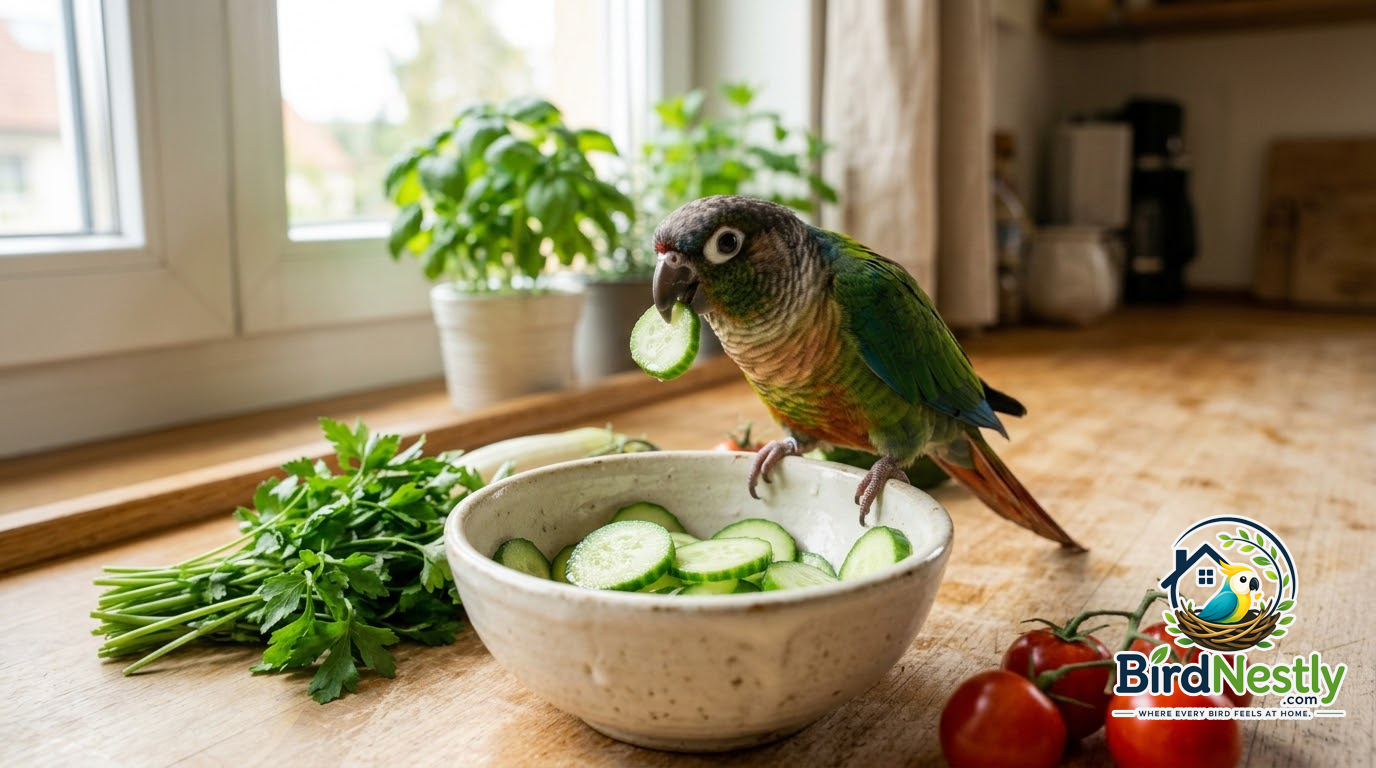
Cucumber can be a useful addition to a parrot’s meals, particularly because it contains a lot of water. Its crisp texture also gives birds something different to hold, tear, and chew.
The main limitation is that cucumber is not especially nutrient-dense compared with some darker or more colorful vegetables. It should therefore be part of a varied selection rather than the only vegetable your parrot receives.
Dark leafy vegetables such as kale can provide a different nutritional profile, while carrots are a useful source of beta-carotene. Cauliflower and other vegetables can also be rotated into meals to keep the selection varied.
The high water content of cucumber is worth remembering. After eating watery vegetables, some parrots may produce droppings that look wetter than usual. This can happen because the bird is taking in more water, rather than because it has developed diarrhea.
Cucumber can also be enjoyable simply because of its texture. A parrot may grab a piece with one foot, nibble around the edges, or pull it apart with its beak. There is no need to encourage a bird to eat it if it shows no interest. Plenty of other vegetables can be offered instead.
3. Can Parrots Eat Raw Cucumber?

Yes, raw cucumber is a simple way to serve this vegetable to a parrot. It does not need to be cooked, and many birds enjoy the crisp texture. A fresh piece can be cut into a size that your bird can easily hold and eat.
Wash the cucumber thoroughly under running water before cutting it. Remove any soft, damaged, moldy, or spoiled areas. For smaller parrots, thin slices or small pieces are easier to handle than a thick section of the stalk.
There is no need to add anything to the cucumber. Avoid salt, oil, butter, sauces, dressings, garlic, onion, or other seasonings. Fresh and plain is the better choice.
When offering cucumber for the first time, start with a small piece. Your parrot may nibble it immediately, play with it, or ignore it completely. Some birds are simply more interested in crunchy vegetables than others.
Cucumber can also be served alongside other vegetables. Broccoli, carrots, and kale can give your bird a wider selection of flavors, textures, and nutrients.
4. Can Parrots Eat Cucumber Skin?

Yes, parrots can eat cucumber skin when the cucumber has been washed thoroughly. There is no need to remove the skin simply because you are preparing it for your bird.
The most important part is cleaning the outside of the cucumber before cutting it. Rinse it well under running water and gently rub the surface to remove dirt and anything left on the skin.
If the cucumber has damaged or spoiled areas, cut those sections away. Do not give your parrot cucumber that is slimy, moldy, unusually soft, or has an unpleasant smell.
Leaving the skin on can also give your parrot a slightly different texture to explore. Some birds enjoy peeling and tearing at the outside before reaching the softer flesh inside.
For a small parrot, cut the cucumber into manageable pieces rather than handing over a large whole cucumber. This makes it easier for the bird to hold and chew.
If you are unsure about the cleanliness of the skin, peeling it is another option. Either way, the cucumber should be fresh, clean, and served without salt, seasoning, or other ingredients.
5. Can Parrots Eat Cucumber Seeds?
Yes, the soft seeds found inside a fresh cucumber can be eaten by parrots. There is no need to spend time removing each seed before giving your bird a piece of cucumber.
The seeds inside a normal fresh cucumber are soft and surrounded by the watery flesh. For most parrots, they can simply be eaten along with the rest of the vegetable.
The same basic preparation still applies. Wash the cucumber thoroughly before cutting it, check that it is fresh, and remove any spoiled sections. Never serve cucumber that has mold, a slimy surface, or an unusual smell.
For smaller parrots, cut the cucumber into small pieces so the bird can hold and chew them comfortably. Larger parrots can usually manage a bigger piece, but there is still no need to give a large amount at once.
You may notice that some parrots go straight for the softer center and leave parts of the skin behind. Others may chew through the entire piece. Either is fine. Birds can have very different preferences when it comes to texture.
6. How Much Cucumber Can a Parrot Eat?
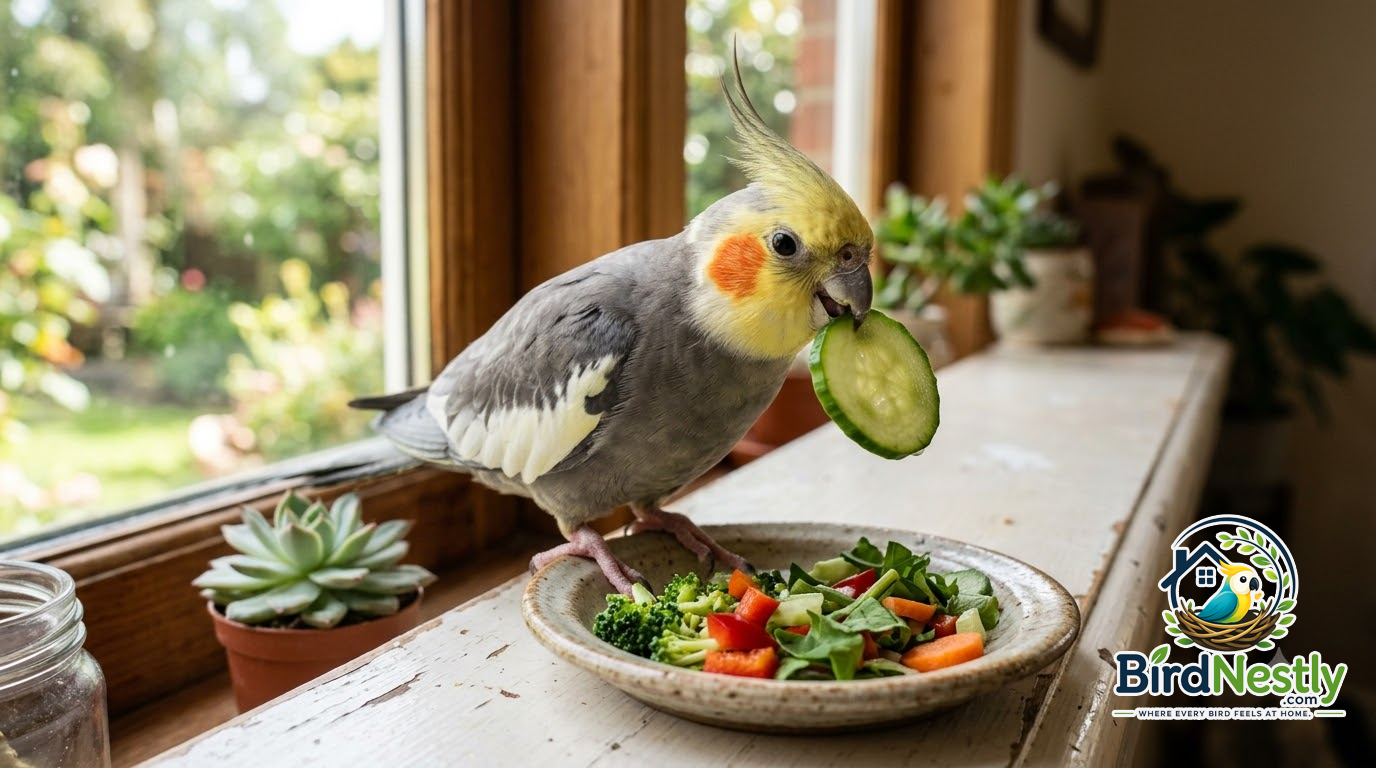
The right amount depends on the size of the parrot and what else is included in its diet. A Budgie or Lovebird needs much less food than an African Grey, Amazon, or Macaw, so the same serving should not be used for every bird.
For a small parrot, a few small pieces are enough to start. Medium-sized parrots can have a little more, while a larger parrot can handle a larger piece. The important point is that cucumber should remain part of a varied selection of vegetables rather than becoming most of the meal.
Because cucumber contains a lot of water, giving a large amount at once may make your bird’s droppings appear wetter than usual. That change can simply come from the extra water in the food.
There’s also no reason to encourage your parrot to finish a large portion. A few bites may be all it wants. Fresh vegetables such as carrots, broccoli, and kale can be offered at other meals or alongside cucumber.
If your parrot has a medical condition, is following a restricted diet, or has unusual changes in its droppings after eating cucumber, speak with an avian veterinarian before making it a regular part of the diet
7. Can Parrots Eat Cucumber Every Day?
Cucumber can be included in your parrot’s regular vegetable rotation, but there is little reason to make it the only vegetable your bird eats every day. The main reason is simple: cucumber contains a great deal of water but relatively little energy and protein. USDA-based nutrition data lists raw cucumber with the peel at about 15 calories and 95.2 g of water per 100 g, with only 0.65 g of protein and 0.5 g of fiber.
That high water content is useful to understand when deciding how often to offer it. A parrot may enjoy cucumber and eat quite a bit if given the opportunity, but eating a large amount can leave less room for vegetables that provide more concentrated nutrients.
Veterinary guidance from VCA recommends that fresh vegetables, fruits, and greens generally make up around 20%–40% of a parrot’s daily diet, with the exact amount depending on the species and feeding plan. For Amazon parrots, VCA recommends keeping fresh fruits and vegetables to no more than about 40% of daily intake and making nutritionally complete pellets the foundation of the diet, around 60%–70%.
For African Grey parrots, VCA gives a somewhat different range, recommending fresh fruits and vegetables at no more than 20%–40% while pellets make up approximately 75%–80% of the diet. These differences are a good reminder that there isn’t one serving percentage that works perfectly for every parrot.
Cucumber itself is included among the vegetables VCA suggests for parrots, alongside foods such as carrots, broccoli, kale, cabbage, spinach, and zucchini. So there is no need to avoid cucumber simply because it contains a lot of water. The better approach is to offer a small portion and rotate it with other vegetables.
For example, you could give a few pieces of cucumber together with broccoli or carrots rather than filling the entire vegetable dish with cucumber. On another day, kale or cauliflower can provide a different combination of nutrients and texture.
There is another reason not to be surprised by changes in your bird’s droppings after eating cucumber. VCA explains that birds eating fruits and vegetables with high water content may produce more urine, which can make the droppings appear wetter. This is called polyuria and is different from true diarrhea.
So, if your parrot eats cucumber and you notice a wetter dropping shortly afterward, look at the whole picture rather than assuming the food has caused an illness. If the change continues when your bird is no longer eating watery produce, or it occurs together with loss of appetite, lethargy, weight loss, or other unusual signs, an avian veterinarian should be consulted.
One final point is important: fresh cucumber should never replace fresh drinking water. VCA recommends that parrots have clean, fresh water available at all times.
For most healthy parrots, cucumber works best as one small part of a varied vegetable selection. It can provide water, crunch, and something interesting to chew, while other vegetables help cover the nutritional needs that cucumber alone cannot provide.
FAQs
Can parrots eat cucumber?
Yes. Cucumber is listed among the vegetables that can be offered to parrots. It should be washed thoroughly and cut into pieces that are suitable for the size of the bird. (Vca)
Is cucumber safe for parrots?
Fresh cucumber is generally considered a suitable vegetable for parrots when served properly. It should be fresh, clean, and free from seasonings or sauces. (Vca)
Can parrots eat raw cucumber?
Yes. Raw cucumber can be served in small pieces. There is no need to cook it before giving it to your bird.
Can parrots eat cucumber skin?
Yes. The skin does not have to be removed, provided the cucumber is washed thoroughly before feeding. (Vca)
Can parrots eat cucumber seeds?
The soft seeds inside a fresh cucumber can be eaten together with the flesh. There is no need to remove them individually.
How much cucumber can a parrot eat?
There is no single portion that suits every parrot. A few small pieces are a sensible starting point, particularly for smaller birds. Cucumber should be part of a varied selection rather than the main food.
Can parrots eat cucumber every day?
Cucumber can be included in a regular vegetable rotation, but variety is important. VCA recommends offering small pieces of different fresh fruits and vegetables rather than a large amount of one food. (Vca)
Can cucumber make a parrot’s poop watery?
It can make droppings appear wetter because cucumber contains a high amount of water. Extra liquid in the droppings after eating water-rich produce may be polyuria, which is different from true diarrhea. (Vca)
Can cucumber help keep a parrot hydrated?
Cucumber contributes water to the diet, but it should never replace drinking water. Fresh, clean water should remain available to parrots at all times. (Vca)
Can parrots eat cucumber peel?
Yes. Cucumber peel can be left on after the vegetable has been washed thoroughly. Cutting it into manageable pieces is more important for smaller birds. (Vca)
Can parrots eat pickled cucumber?
Fresh cucumber and pickled cucumber are very different foods. Pickled cucumber often contains added salt and other ingredients, so it is better to give parrots fresh, plain cucumber instead.
Can baby parrots eat cucumber?
Young birds have different nutritional needs from adult parrots. Cucumber should not displace the nutritionally complete food appropriate for a growing bird. Ask an avian veterinarian before making it a regular part of a young parrot’s diet.
What should I do if my parrot has diarrhea after eating cucumber?
A wetter dropping immediately after eating a water-rich vegetable does not necessarily mean diarrhea. True diarrhea involves a change in the fecal portion itself. If abnormal droppings persist for more than 24 hours, veterinary attention is recommended. (Vca)
Should cucumber be washed before giving it to a parrot?
Yes. Wash it thoroughly before serving to remove dirt, chemicals, and potentially harmful bacteria. (Vca)



Write Your Review
No reviews yet. Be the first to share your experience!